
Vietnamese Human Hair
How to Choose Vietnamese Curly Hair: Top 5 Textures Compared (2026)
Jun
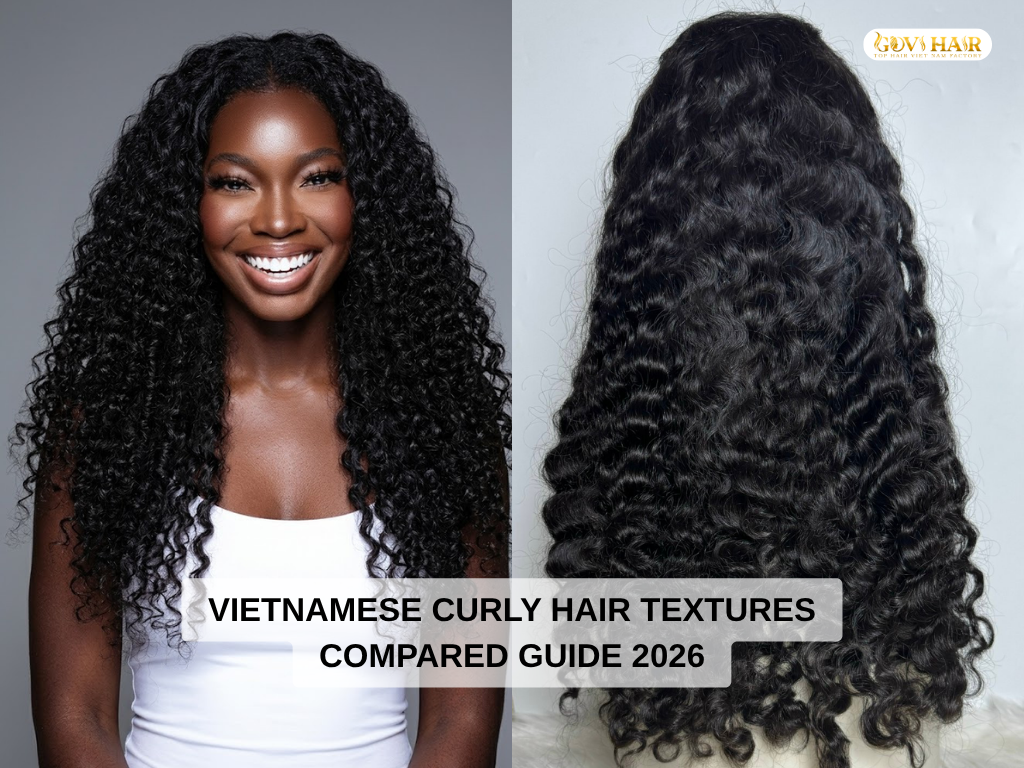
Is Vietnamese curly hair naturally curly, or steam-set afterward? Both exist on the market. Buyers searching for Vietnamese curly hair extensions or raw curly bundles are often comparing these two different products without realizing it – and the difference isn’t just about looks. It decides how long the curl holds, how the hair takes color, and how much extra work you’ll do in the salon.
At Govihair, our raw curly bundles keep the exact pattern the donor was born with. Nothing is added, and nothing is steamed in afterward – it’s one texture within our full raw curly bundles line. A sample order starts at 500g, and in-stock curly textures reach the US in 5–7 days, so a wholesale buyer can confirm what they’re actually getting before ordering more.
What Is Vietnamese Curly Hair – Natural Curl or Permed?
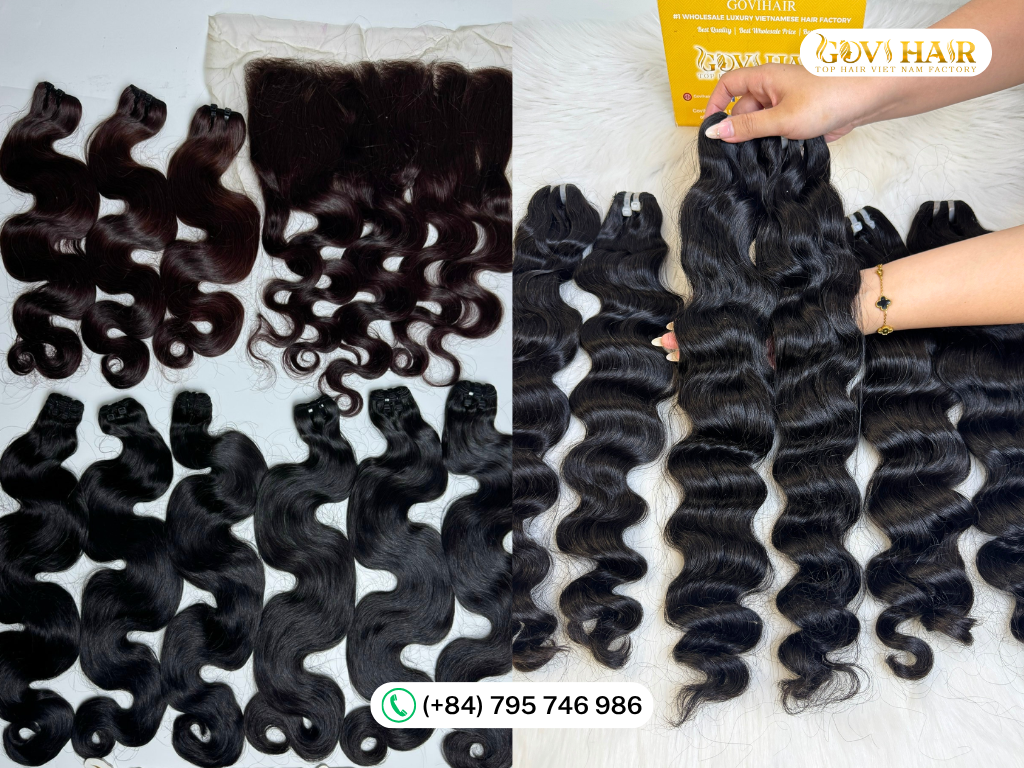
Two different products get sold under the same “curly” label, and buyers deserve to know which one they’re buying. Raw Vietnamese curly hair is 100% unprocessed – no chemicals, no heat, no steam. The cuticle stays fully intact and lined up from root to tip. What you see is simply the donor’s own texture, so it holds up through washing, humidity, and time the same way it did on the donor’s head.
Steam-set curly hair, sometimes just called “virgin curly,” starts from straight or wavy donor hair that’s still chemical-free. The curl is added afterward, by wrapping the hair around rods and applying steam. It looks good on day one. After a few washes, though, the pattern slowly loosens, because the curl was never built into the strand to begin with.
Here’s why the two are so easy to mix up in photos. Natural curl comes from the donor’s own DNA – the outer layer of each strand doesn’t lie flat and even the way straight hair’s does, so the strand bends into a curl from the moment it’s cut.
Steam-set curl starts from straight donor hair – most raw Vietnamese hair grows straight – and hot steam bends the strand into a curl shape without drying it out, which is why it still looks shiny and natural. In fact, more than 90% of curly hair sold on the market today is steam-set. That’s exactly why asking a supplier directly, instead of trusting the listing photos, matters so much.
This is why buyers should ask suppliers directly which process made the curl before placing a bulk order. A supplier who can answer clearly, and prove it, is one worth building a repeat relationship with.
Do Vietnamese Women Naturally Have Curly Hair?
Most Vietnamese women have straight or lightly wavy hair. Natural curl does occur, though – mainly among donors from mountainous regions and ethnic groups outside the Kinh majority. To supplement that limited supply, some of Govihair’s natural-curl stock also draws on Cambodian donor hair, which carries a naturally light wave of its own. Either way, that curl is rare, and rarity is why genuine raw curly hair costs more than steam-set curl. If a supplier offers unlimited raw curly stock in every length and color, that volume alone is worth asking about – a real raw-curly supply chain is naturally limited by how much of it exists to collect.
What Types, Grades, and Lengths of Vietnamese Curly Hair Are Available?
Vietnamese curly bundles come in a few recognizable patterns – most commonly Burmese curly hair, pixie curly hair, bouncy curly, and deep wave curly hair. Each has a slightly different curl size and bounce, so the right choice depends on the look your client base wants. On top of texture, the hair is also organized by donor sourcing and by same-length grading, and the two systems work together. Here’s how the five best-selling textures compare:
| Texture | Curl Pattern | Available Lengths | Best Suited To | Top Markets |
|---|---|---|---|---|
| Body Wave | Loose, wide S-shaped wave – gentle, snake-like movement | 8″–30″ | Works well in both virgin and raw hair | Americas, Africa |
| Deep Wave | Deeper, more defined S-shape than body wave – bouncy but not tightly curled | 10″–30″ | Best in virgin hair; the wide wave is easy to process and doesn’t need the stretch a tight curl needs | Americas, Africa |
| Burmese Curly | Natural 3B–3C curl – larger, looser curls with high natural shine | 10″–30″ | Best in raw hair; the loose curl needs strong, natural strands to hold its shape when bundles are blended for volume | US, UK |
| Bouncy Curly | Very stretchy, round, springy curls | 10″–30″ | Best in raw or high-grade virgin hair, since even, round curls need natural bounce | Nigeria |
| Pixie Curly | Smaller, tighter, more uniform curls than Burmese | 10″–30″ | Best in raw hair; the tight, small curl needs an intact cuticle to hold a crisp pattern without stretching | US, Nigeria |
Donor Tiers
| Donor Tier | Curl Consistency | Typical Lifespan | Best Fit |
|---|---|---|---|
| Single-donor / baby hair | Most even curl and bleach lift | 3–5 years | Premium wigs, repeat high-end clients |
| 2–3 donor | Slightly less even, still fully raw | 2–3 years | Core wholesale volume |
| Mixed-donor | Thickest ends, most competitive price | Shorter than single-donor | High-volume, price-sensitive orders |
Grades & Lengths
Grading (Double drawn, Super, Luxury) sits on top of donor tier. It describes how even the length is within a bundle. Super and Luxury grades have clearly thicker ends, which matters for curly textures – thicker ends hold a curl pattern and color treatment longer.
On length, Govihair’s curly line runs 8″ to 40″, with the strongest in-stock depth between 16″ and 24″ – that’s the range most salons reorder without waiting on production. Anything past 26″ is usually made to order, since fewer donors naturally grow curl at that length without blending strands.
Our best-selling curly hair lines right now are Deep Wave, Burmese Curly, and Pixie Curly. Salons keep reordering them for the defined curl, natural volume, and how easily they style.
How Is Vietnamese Curly Hair Made – Natural or Steam-Set?
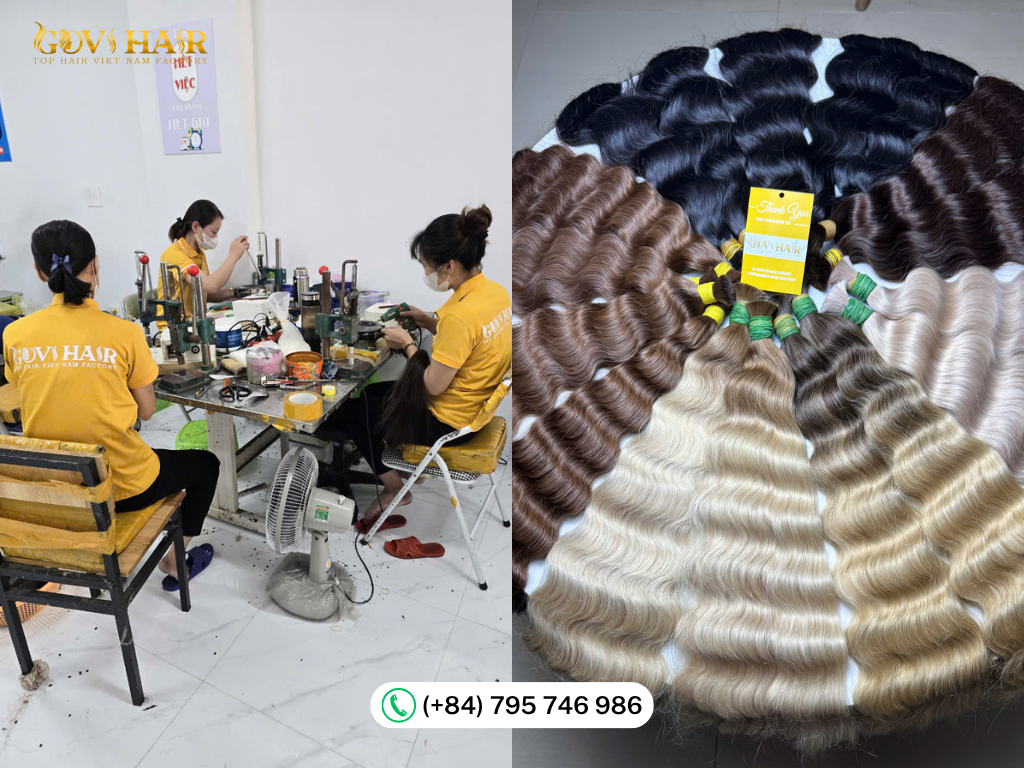
Govihair’s curly hair line is made at our workshop in Da Nang, Vietnam, where our team has worked with raw Vietnamese hair for 10 years. Every curly bundle keeps the donor’s original texture from collection through to packing – nothing is added at any stage.
Before the balance on any order is due, we send a video showing each bundle weighed on a scale, with the actual curl pattern visible on camera. Only after a buyer reviews and approves that video does the balance get paid, in stages, tracked until it arrives. This step exists because curl pattern and texture are the easiest things to fake in photos alone.
How Do You Choose and Care for Vietnamese Curly Hair When Buying Wholesale?
Choosing the Right Donor Tier
Choosing between donor tiers comes down to what your business needs most. Single-donor curly hair costs more, but it holds its curl pattern and color evenly for the longest time – a good fit for buyers building a premium, repeat-client wig line. Mixed-donor curly hair costs less and gives fuller ends, which works well for buyers placing bigger orders where price matters more than perfectly even length.
To be honest about the price difference: raw curly hair costs more than steam-set curly hair. It’s harder to find donors whose hair already grows curly than to steam any straight bundle into a curl shape that won’t last. That’s why raw curly usually costs the most within each length range. But it lasts longer, too – most raw curly hair, cared for properly, holds its pattern for 2 to 5 years depending on donor tier, while a steam-set pattern loosens a little more with every wash.
MOQ, Pricing & Ordering Process
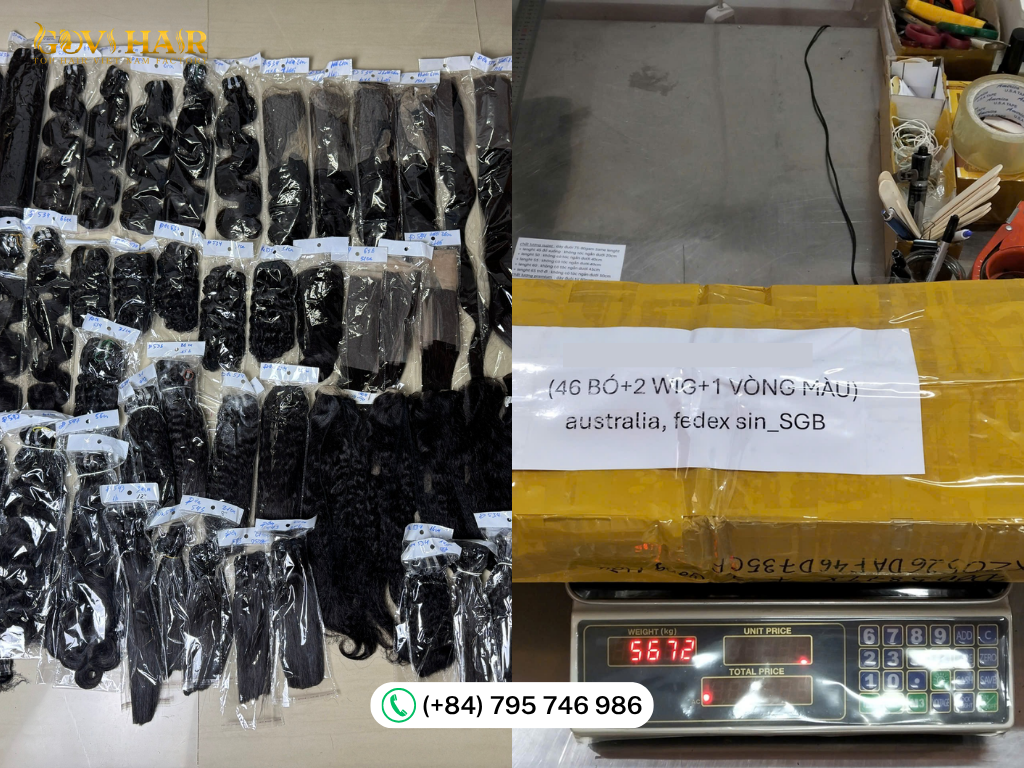
A sample or first wholesale Vietnamese curly hair order starts at 500g (roughly 5 bundles) – enough to test the wash and wear before ordering more. There’s no limit on order size after that. A 30% deposit starts production, video confirmation follows before the balance is due, and closures or frontals ordered alongside bundles are cut from the same donor lot – so curl pattern, density, and color match without any extra work on your end.
Payment Methods
Govihair accepts bank transfer (T/T) in USD and EUR, Western Union, MoneyGram, Ria, Remitly, Wise, Revolut, Lemfi, SendWave, credit card via secure payment link, and USDT (TRC20). Local agent payment is available in Nigeria, Ghana, Cameroon, Ivory Coast and selected African markets. Available methods vary by market. Your sales representative will confirm which options apply to your order and send the payment details directly. Production begins after a deposit from 30%.
Shipping & Custom Orders
In-stock curly hair textures usually ship within 5–7 days. A custom curl pattern, length, or color takes 7–9 days of production before it ships.
Caring for Vietnamese Curly Hair
Washing matters more with curly textures than with straight hair. Handle curly hair gently – work conditioner through with your fingers instead of scrubbing, avoid high heat when drying every day, and let the curl reform with water and a light styling product instead of reshaping it with a flat iron each time. Rough brushing or too much heat is what causes a genuine raw curl pattern to loosen too soon – not the hair itself failing.
One buyer we can point to directly is Lasondra, who ordered our Pixie Curly and Deep Curly bundles. She came back impressed – thick, full bundles with well-defined curls, and rated the overall quality excellent.
Where Do Wholesale Buyers Source Vietnamese Curly Hair?
Wholesale buyers comparing Vietnamese curly hair vendors are usually asking a few key questions beyond the price list: is the curl really raw, can the supplier prove it before the balance is due, and will a repeat order actually match the first one.
Ask whether a vendor will show you the real bundles on video before you pay the balance – that’s the fastest way to rule out a supplier selling steam-set curl as raw. Ask whether closures and frontals come from the same donor lot as the bundles, not sourced separately, so the curl pattern still matches once everything is installed. And ask to see a real finished order, not just catalog photos – Lasondra’s Pixie Curly and Deep Curly order above is the kind of result a genuine wholesale curly hair vendor should be able to point to.
Govihair’s minimum order is 500g, so a first-time buyer can test one texture against these questions before ordering the full catalog.
Ready to compare stock by length and grade? Browse Govihair’s wholesale curly bundles.
Final Thoughts
The short version: Vietnamese curly hair can be genuinely natural or steam-set, and the two aren’t the same once they’re on a client’s head. Raw curly hair costs more upfront, but it holds its pattern for years instead of washes. For a wholesale buyer, the safest move is asking directly how the curl was made, and asking for proof before the balance is paid – a supplier confident in their process will show you, not just tell you. If you’re also sourcing Burmese curly wigs or other curly textures alongside raw bundles, our curly hair category page shows what else is available by length and grade.
Contact Govihair for Orders & Inquiries:
WhatsApp: +84 795 746 986
Email: [email protected]
Instagram: govihair_vietnamhair_factory
TikTok: govihairvietnam_official
Website: govihair.com
FAQ
Is Vietnamese curly hair naturally curly, or is it permed?
It depends on the supplier. Genuinely raw curly hair keeps the donor’s natural texture with no heat or steam involved. Some curly hair on the market is steam-set afterward, which loosens over time.
What’s the difference between raw curly and steam-set (virgin) curly hair?
Raw curly hair is never steamed – the pattern is built into the strand itself. Virgin curly hair is chemical-free but may be steam-set into shape, so the curl relaxes slowly with washing.
What lengths and grades does Govihair offer for curly bundles?
Curly bundles run 8″ to 40″, with the strongest in-stock depth between 16″ and 24″. Lengths past 26″ are usually made to order. Grades are Double drawn, Super, and Luxury, with Super and Luxury carrying thicker, more even ends that hold a curl pattern longer.
What is the MOQ, and how is Vietnamese curly hair priced for wholesale?
The minimum order to start at wholesale pricing is 500g, roughly 5 bundles, which also works as a test order before scaling up. Raw curly bundles usually cost the most within each length range, reflecting the extra work it takes to source them. Exact quotes are sent per order based on length, grade, and quantity.
How long does raw curly hair last with proper care?
Typically 2 to 5 years depending on donor tier. Single-donor curly hair lasts longest, mixed-donor curly hair somewhat less, though it stays fully raw either way.
Do closures and frontals match the curl pattern of the bundles?
Yes, when ordered together. Govihair cuts closures and frontals from the same donor lot as the bundles in that order, so curl pattern, density, and color match without extra sourcing.
What payment methods does Govihair accept?
Govihair accepts bank transfer (T/T) in USD and EUR, Western Union, MoneyGram, Ria, Remitly, Wise, Revolut, Lemfi, SendWave, credit card via secure payment link, and USDT (TRC20). Local agent payment is available in Nigeria, Ghana, Cameroon, Ivory Coast and selected African markets. Available methods vary by market. Your sales representative will confirm which options apply to your order and send the payment details directly. Production begins after a deposit from 30%.
How do I verify the hair is genuinely raw curly before paying the balance?
Ask for a video showing the actual bundles on a scale with the curl pattern visible on camera. This is standard practice before any balance payment and the fastest way to confirm what you’re buying.
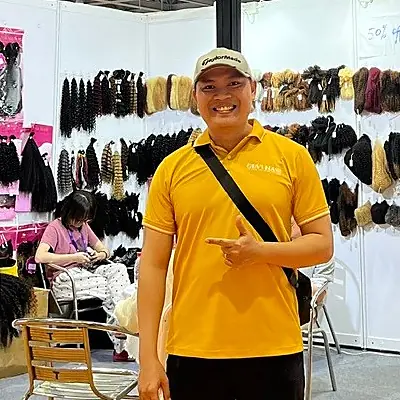
 Ms. Jessica