

Wholesale Hair Vendors
How to Choose a Hair Vendor to Start a Hair Business in 2026 — A 7-Step Beginner Guide

Apr
Choosing the wrong hair vendor is the most expensive mistake new buyers make. It isn’t only the money lost on bad product — it’s the client complaints, the refunds, the reputation damage, and the weeks spent starting the vendor search over.
This guide is written for people starting a hair business in 2026 — salon owners building a first wholesale supply chain, entrepreneurs launching a wig brand, and dropshippers looking for a reliable Vietnamese supplier. Work through the steps in order.
Step 1 — Define your business model, budget, and products
The vendor that’s right for a Dallas salon owner is not the vendor that’s right for a Lagos wig distributor. Before you contact a single supplier, answer these questions and write the answers down.
Who is your customer? US salon clients want premium raw grades and HD lace. Nigerian distributors need volume-friendly virgin grades and flexible payment. European clients with fine hair want natural-looking, low-maintenance extensions. Black women buying wigs, older clients looking for coverage, and trend-driven clients wanting fashion colors all need different product. Your customer’s expectations set your quality tier, texture, and color range.
What’s your business model — and your strength? Pick the model that matches what you’re actually good at:
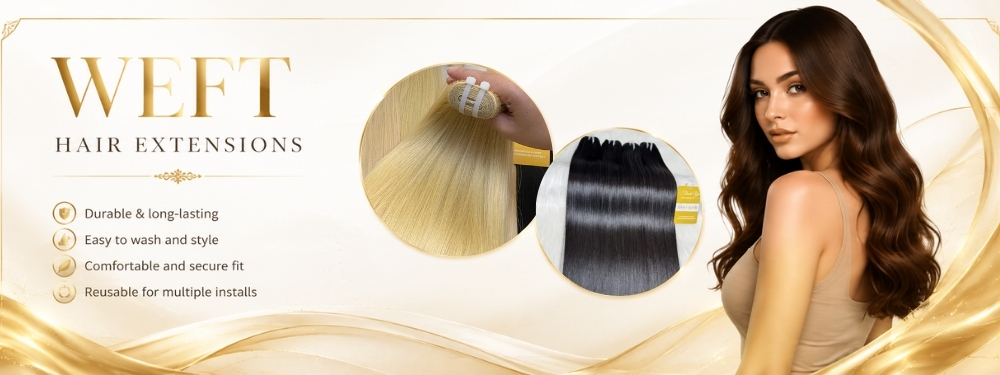
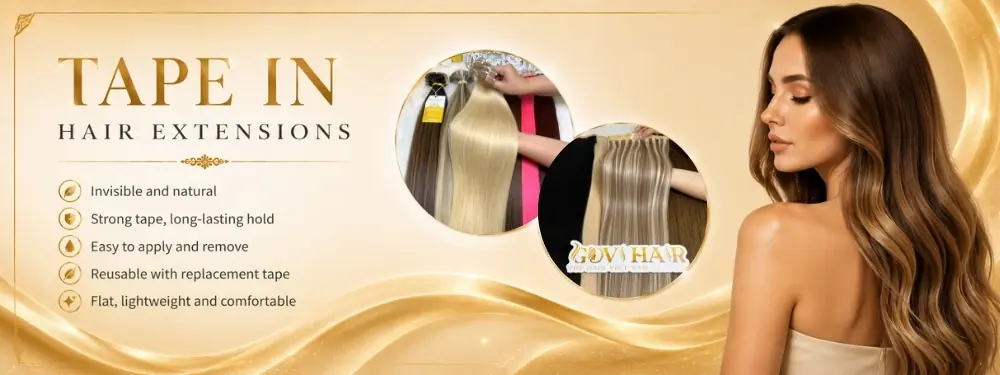
- Extension salon — find out which techniques are trending in your area first: tape-in, keratin tip, weft, genius weft, or nano ring. Stock for those.
- Wig shop — identify the textures your clients buy most: straight, body wave, natural wave, deep wave, or Burmese curly.
- Hairstylist / installer — you can build wigs and sell finished units, not just bundles.
- Retailer — you carry a wider catalog across extensions and wigs.
Choosing a model around your strength keeps you from wasting money on product you can’t sell or service.
What’s your starting budget? First inventory doesn’t need to be large. Most successful hair businesses started with $300–$800 in initial stock for sampling plus a small first order. Budget determines which grade you start with — not which vendor. Good vendors serve buyers at multiple price points, so a small budget is not a reason to accept a worse supplier. A useful benchmark: Govihair’s sample minimum is 500g (~5 bundles) or 2 wig units, which is enough to test quality without over-committing.
What’s your market’s price ceiling? Work backwards from the highest realistic retail price in your market to the landed cost you need from the factory to keep your margin. As a 2026 reference, raw Vietnamese bundles run about $22–$55 per 100g for lengths up to 22″, depending on grade — that’s the range you’re building your margin math on.
[TODO — Vivi bổ sung]: tư vấn “case by case” theo góc chuyên gia để khách chọn đúng hướng đi (mở salon nối / wig shop / retail…), tránh tốn thời gian – tiền – công sức. Mình đã dựng khung tiếng Anh ở trên; bạn muốn thêm ví dụ tư vấn cụ thể thị trường nào thì gửi để mình viết tiếp.
Step 2 — Score every vendor against the 7-criteria checklist
Run this checklist on every vendor you evaluate, without exception. Each criterion has a clear pass/fail.
- Can they show you a live factory on video call? This is the single most important test. Request a WhatsApp video call during Vietnam business hours (UTC+7) and ask to see the factory floor with workers present, current raw stock, and a paper with your business name held next to the hair. Pass: live video within 24–48 hours. Fail: resistance, delay beyond 5 business days, or pre-recorded content only.
- Can they verify their business registration? Ask for the official Business Registration Certificate. The company name on the certificate, the factory address on their website, and the bank account name you’d wire to must all match. Pass: certificate provided, names and address match. Fail: certificate unavailable, name mismatch, or a different entity receiving payment.
- Do they offer sample orders? Every legitimate vendor offers samples — it’s standard practice, not a negotiation. Govihair’s minimum is 500g (~5 bundles) or 2 wig units. Pass: samples available and delivered within the production timeline. Fail: any refusal, or unusually high sample minimums from a vendor presenting as wholesale.
- Is their pricing within the realistic market range? Raw Vietnamese bundles in 2026 cost about $22–$55/100g for lengths up to 22″, depending on grade; frontal wigs run roughly $85–$260+ depending on construction and density. If a quote sits far below these ranges for “raw” or “premium” hair, ask exactly what grade and sourcing justify it. Pass: pricing consistent with the grade claimed. Fail: prices far below market with no credible explanation (usually floor hair, acid-washed hair labeled raw, or silicone-coated hair that degrades in weeks).
- Do they use a 50/50 payment structure? Reputable factories take a 50% deposit to start production and 50% after pre-shipment video confirmation. Pass: 50% deposit confirmed in writing. Fail: full upfront payment required from a first-time buyer.
- Do they offer pre-shipment video confirmation? Before the final 50% is released, you should see your specific order on a calibrated scale confirming weight, plus a visual texture check. This kills the most common fraud — deposit paid on one quality, inferior product shipped. Pass: pre-shipment video call offered as standard. Fail: no confirmation step, or vague promises.
- Do they have independent reviews going back 12+ months? Search the factory name on YouTube, Google, and social media for buyer unboxing videos and factory tours from sources independent of the vendor’s own site. Pass: multiple independent sources with consistent feedback over 12+ months. Fail: reviews only on the vendor’s own website, or content that feels templated or recent-only.
Step 3 — Screen out bad vendors with the 7 red flags
If any of these appear, treat it as a stop sign — not something to negotiate around.
- They won’t do a live factory video call. The clearest signal of a middleman or fraud. Real factories show their floor.
- The business name doesn’t match the bank account. You’re being asked to wire money to a different entity than the registered company. This is how many scams work.
- Prices that seem too good. $12/bundle for “raw Vietnamese double drawn” isn’t possible at a real factory given the labor cost of sorting alone. The price reflects the product you’ll actually receive.
- They push back on samples. “We only work with serious buyers” or high minimums instead of a sample means they’re protecting their product from scrutiny.
- 100% payment upfront required. No exceptions. Even established wholesale buyers don’t pay 100% upfront on a first order.
- No tracking number within 48 hours of “shipment.” A factory that can’t produce a real DHL/FedEx/UPS tracking number within 48 hours of claiming it shipped hasn’t shipped.
- Communication that avoids specifics. Vague answers about sourcing, donor origin, processing, or MOQ mean the person didn’t make the product and doesn’t know it.
Step 4 — Verify credibility with documents and independent proof
The video call proves a factory exists. Documents prove the business is real and has actually shipped to customers before you. Ask for these — a legitimate factory produces them without hesitation.
Business Registration Certificate + tax code. Confirm the registered company name, factory address, and a valid tax/VAT code. All three should match the website and the bank account name from Step 2. In Vietnam, an exporter operating legitimately has these on file.
Sample commercial / export invoices from past shipments. Ask the vendor to show a recent commercial invoice or packing list from an earlier order (they can redact the other customer’s name and address). A real exporter has a stack of these; a middleman rarely does. What you’re checking: the company name on the invoice matches the registration, the product descriptions read like a factory’s (grade, length, weight, texture — not vague “hair bundles”), and the values are consistent with market pricing.
Proof of real carrier shipments. Ask for past DHL/FedEx/UPS tracking numbers or shipping records to your region. A factory that exports weekly can show a shipping history; a fraud can’t.
Bank account in the company name. The account you’ll deposit to should be the registered business entity, not a personal name. A mismatch here is the same hard stop as Red Flag 2.
Reference buyers or repeat-order proof. Established vendors have recurring wholesale clients. Ask whether they can share (with permission) a reference buyer in your market, or show anonymized repeat-order history. Repeat orders are the strongest trust signal there is — nobody reorders bad hair.
Save every document, invoice, and transfer receipt in one folder per vendor. If a dispute ever arises, this paper trail is your leverage.
Step 5 — Order a sample and test it before any bulk order
Never place a bulk order with a vendor you haven’t sampled. A sample order does three things: it verifies quality, tests the logistics chain end-to-end, and gives you a physical benchmark to check the bulk against later.
Sample size: 500g (~5 bundles) or 2 wig units is the standard verification order. Big enough to test properly, small enough that a bad result costs you little.
Ship it to yourself and time it. Note how many days it takes and which carrier they use. As a 2026 reference, all-in air freight from Vietnam to the US runs roughly $42 at 0.5kg and $45 at 1kg (indicative, before peak-season surcharges and import duties). Reliable 5–7 day delivery to your primary market is what you’re verifying.
Run the four arrival tests in Step 7 on the sample. Only if the sample passes do you move to a bulk order — and you keep the sample to compare the bulk against.
Step 6 — Place your first bulk order with 50/50 payment
The first bulk order should verify that quality scales from sample to production — not maximize inventory.
First bulk size: 500g–1kg of bundles (5–10 bundles) OR 2–3 wig units. Enough to confirm the bulk matches your sample.
Payment: 50% deposit to start production, 50% after pre-shipment video confirmation. For US buyers, common methods are bank wire, Wise, or Zelle; Govihair also supports Western Union and other options by market. Keep a record of every transfer and the invoice it corresponds to.
Before the final 50%: insist on the pre-shipment video — your order on a calibrated scale confirming weight, plus a texture/color check on camera. This is the step that prevents “paid for double drawn, received single drawn.”
Step 7 — Run full quality control on arrival, then scale
QC has two layers: what you test when the box arrives, and what you should confirm the factory does before shipping. A good vendor is transparent about both.
Test the hair yourself on arrival
- Cuticle slide test — run your fingers tip-to-root and feel slight resistance. Present = intact, aligned cuticles. Absent/too smooth both ways = acid-washed or silicone-coated.
- Elasticity test — wet a strand and stretch lightly. It should stretch a little and snap back. Snapping or staying stretched signals over-processing.
- Burn test — burn a few strands. Genuine human hair burns to crumbling grey-white ash with a hair-protein smell. Synthetic blends melt into hard black beads.
- Shedding test — comb firmly from root to tip and count strands released. A quality bundle sheds minimally on the first comb.
- Weight & length check — weigh the order and confirm it matches the invoice; measure lengths. Underweight bundles or short-measured lengths are the most common quiet cheat.
- Grade check — for “double drawn,” most strands should run close to the labeled length with few short hairs. As a reference, Remy grades break down roughly as: Single <65% · Double 65–75% · Super 75–85% · Luxury 85%+ thickness retained root-to-end (Raw grades run a little lower). “Super” means no strands under ~35–40cm. If a “double drawn” bundle is thin at the ends, it isn’t the grade you paid for.
- Color consistency — check that color is even across bundles from the same order, especially for bleached or blonde shades.
Record your unpacking on video, in one continuous take. Documented unpacking is the evidence you need for any quality claim with the supplier.
Ask the vendor about their factory-side QC
A transparent factory can explain its own process. Reasonable answers look like: raw material sorted and graded by short-hair ratio (that’s what makes double drawn / super consistent), cuticles kept aligned root-to-end, weight verified on a calibrated scale before shipment, and — for curly textures — hand-curling by experienced artisans followed by low-temperature steam setting (around 70–80°C for 1–2 hours) to lock the pattern without scorching the hair.
One honesty check worth asking about: bleached-then-curled hair holds curl less reliably after washing, because bleaching lifts the cuticle. A vendor who tells you this straight — rather than promising a permanent curl on bleached hair — is one who understands the product. For colored curly, quality depends heavily on starting with strong raw material.
Evaluate before scaling. Install it, sell it, watch how your clients respond. Scale to larger recurring orders only after real-world performance confirms the vendor relationship is solid.
Choosing your first products by business model
The seven steps above apply to everyone. These specifics help you pick what to order first.
Salon building a wholesale supply chain. You need consistent quality across batches — the same 18″ double drawn body wave should perform the same in January and July. Ask about batch-to-batch consistency and repeat orders from the same collection region. Start with: bone straight and body wave in double drawn, 16″–22″, plus 4×4 transparent closures. Begin with natural #1B until you learn your clients’ color preferences.
Wig brand. You need OEM capability (custom packaging, labels) and consistent construction. Look for a dedicated wig team and HD lace, and ask to see QC photos from wig production, not just finished shots. Start with: 13×4 frontal wig, bone straight, 180% density, 18″–20″, natural black, pre-bleached knots and pre-plucked hairline.
Dropshipping. You need per-unit shipping with no MOQ pressure, product photos/video for your store, reliable 5–7 day delivery, retail-ready packaging, and confirmation the vendor won’t include their own branding or pricing in the parcel.
Distributor supplying other businesses. You need volume tiers, production priority for recurring orders, and the ability to mix product types per order. Discuss pricing at 5kg vs 20kg vs 50kg monthly upfront, and confirm capacity to scale without lead-time problems.
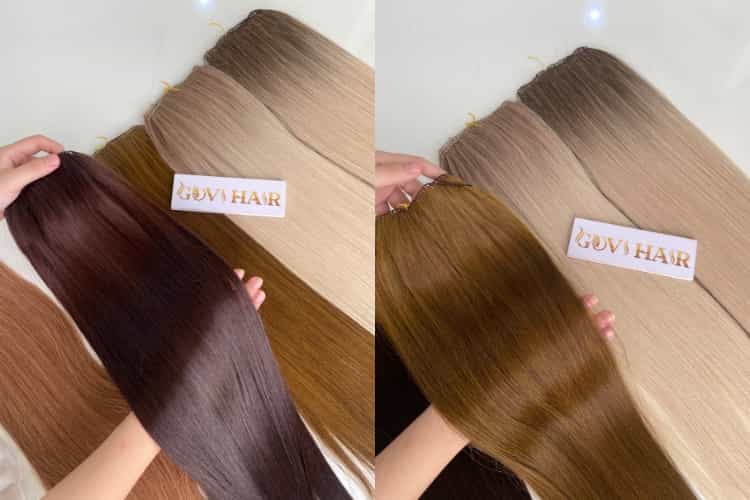
Case study: how a first-time US buyer got it right
A salon owner in Houston, Texas wanted to sell hair in-house instead of asking clients to source their own. Budget for first inventory: $600.
She messaged three Vietnamese vendors on WhatsApp and requested a live video call from each. Two sent pre-recorded factory tours. One (Govihair) did a live call within 24 hours — factory floor, raw stock, and a cuticle slide test demonstrated on camera.
She placed a 500g sample with Govihair: 3 bundles bone straight double drawn 18″, 1 bundle body wave double drawn 18″, 1 closure. Total ~$180 including 5-day DHL shipping to Texas. On arrival she ran the burn test (passed), cuticle slide (passed), and did a test install on a client — the hair held its style for 3 weeks before the first wash, with no shedding complaints.
Her first bulk order: 8 bundles bone straight, 4 body wave, 4 closures. She paid a 50% deposit ($220), saw the pre-shipment video, released the balance; it arrived in 6 days. Three months later she orders monthly at 15–20 bundles plus wigs on a negotiated recurring rate.
The pattern: start small, verify quality, test real-world performance, scale only once confidence is established.
Timing matters: launch into the Q4 peak, not after it
She started her vendor search in September. That was deliberate — and it’s the single easiest advantage a beginner can give themselves.
Hair demand is heavily seasonal. Christmas and the New Year period is the biggest buying window of the year: sellers commonly see order volume rise 5–10× above a normal month as clients buy installs, wigs, and gifts for the holidays. A new business that has stock on the shelf during that window can do in six weeks what would otherwise take half a year.
The catch is that the 7 steps above take time. Sampling, testing, a first bulk order, and a second production run add up to roughly 6–10 weeks before you’re holding sellable inventory. Work backwards:
| When | What you should be doing |
|---|---|
| Sept – early Oct | Vendor vetting (Steps 1–4), request samples |
| Mid Oct | Sample QC testing, choose your vendor |
| Late Oct – early Nov | First bulk order, 50% deposit, production |
| Mid–late Nov | Stock in hand, listings live, marketing started |
| Dec – early Jan | Peak selling; place restock orders early |
Two practical notes. First, set aside a dedicated restocking budget before the peak — the most common Q4 mistake is selling out in week two with no cash free to reorder. Second, book shipping early: peak-season carrier surcharges apply in Q4 and are not included in standard air-freight quotes, and lead times stretch as global volume rises. Ordering in November costs less and arrives faster than ordering in December.
If you’re reading this outside Q4, the same logic applies to your own market’s peak — back-to-school, wedding season, or major local holidays.
Where to source: Vietnam, China, or Russia
Beginners usually start by comparing individual vendors. It’s more useful to first compare origins, because each sourcing region has a different structure, price level, and color range. Here’s how the three main options compare on public 2025–2026 pricing.
| Vietnam | China | Russia | |
|---|---|---|---|
| Typical price (natural, 100g) | ~$22–55 | ~$22–77 | ~$310–430 (weft, 20–28″) |
| Sample MOQ | From 500g | Low (stock-based) | High — commonly ~$3,000 |
| Sourcing model | Domestic collection + factory processing | Large-scale processing, raw imported from multiple countries | Domestic Russian donor hair |
| Color range | Full range: natural → platinum, bleachable | Widest, incl. vivid/piano/ombre | Natural cool tones only; no fashion colors |
| Best for | Beginners, salons, wig brands, most markets | Stock/dropship volume, fashion colors, wig supplies | Luxury niche, fine European hair |
Russia produces genuinely excellent fine hair — single-origin donor hair with intact, aligned cuticles and no silicone coating. But the economics are hard for a beginner: prices run roughly 4–5× Vietnamese rates, minimums are often around $3,000, and the color range stops at natural cool tones with no platinum or fashion shades. It’s a niche for price-insensitive luxury clients, not a first supply chain.
China has enormous scale and the broadest color palette on the market — vivid shades, piano, ombre, and reliable #613/platinum processing — plus deep stock inventories and dropship-friendly logistics. Two things beginners should understand: much of the raw material is imported from other countries and re-labeled by region, so “Brazilian” or “Peruvian” describes a product line more than an origin; and on published 2025 pricing, natural hair from major Chinese factories sits at $22–77/100g — level with Vietnamese pricing, not below it. Where China is genuinely unbeatable is supplies: net caps, lace, glue, tools, tape, and mannequin heads. Many successful sellers buy hair from Vietnam and accessories from China.
Vietnam sits between the two. Hair is collected domestically and processed in-country, which means one origin rather than a blend, at prices well under Russian rates and level with or below Chinese rates. Raw Type 1 (single-donor) lifts to any shade including platinum, so you’re not choosing between natural quality and color range. And sample minimums are low — 500g is enough to test a factory properly.
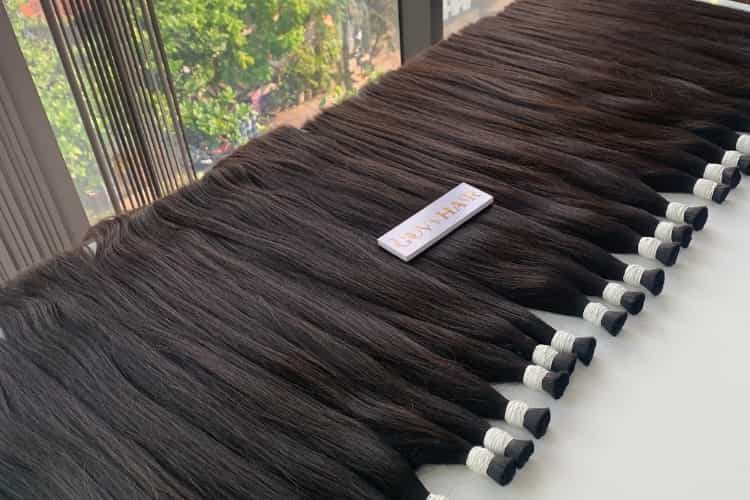
For a first-time buyer, Vietnam is usually the right starting point for one practical reason above all: it lets you verify a factory cheaply. A $180 sample order tells you what a $3,000 minimum would have cost you to find out.
Why Govihair works for first-time buyers
Govihair is set up specifically to support beginner wholesale buyers:
- 500g minimum order — no pressure to over-invest before you’ve tested quality
- Sample orders available before any bulk commitment
- Pre-shipment video confirmation on every order, regardless of size
- WhatsApp support in English during Vietnam business hours
- Product recommendations by market — US, Africa, Europe, Middle East
- Payment options including Zelle (US), bank wire, Wise, Western Union, and Binance USDT
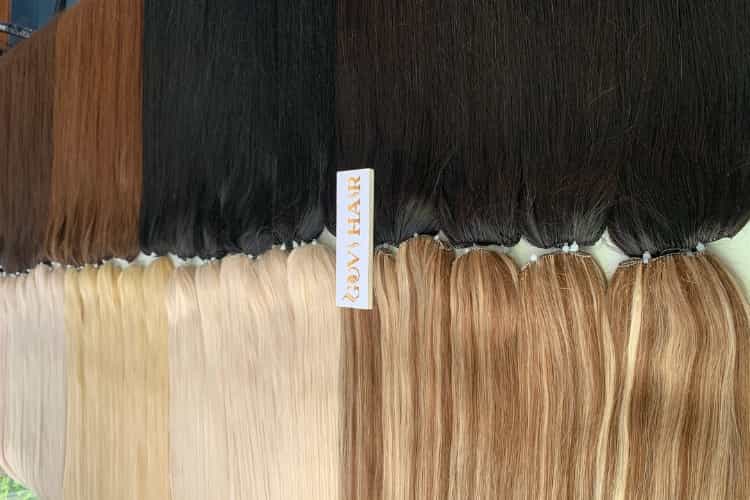
Best starting products by market: bone straight double drawn 18″–20″ natural black (universal); body wave double drawn 18″–20″ (US, Africa, Europe); deep wave 18″–20″ (African market); 13×4 frontal wig, bone straight, 180% density, 18″–20″ (US wig-brand starters).
Contact: WhatsApp +84 79 574 6986 | govihair.com
FAQs
What makes a good hair vendor for starting a business? Seven things: live factory verification, business registration documents, sample availability, market-rate pricing, a 50/50 payment structure, pre-shipment confirmation, and independent reviews going back 12+ months. A vendor who satisfies all seven is worth a sample order; one who fails any of the first three is worth walking away from.
How do I verify a hair vendor is legitimate and not a middleman? Beyond a live factory video call, ask for the Business Registration Certificate and tax code, a redacted commercial/export invoice from a past shipment, and real DHL/FedEx/UPS tracking history. Confirm the bank account is in the registered company’s name. A middleman can rarely produce shipping records or factory-side QC details.
Is Vietnamese, Chinese, or Russian hair better for a beginner? All three produce quality hair, but they suit different buyers. Russian hair is excellent fine hair at roughly 4–5× Vietnamese pricing with minimums often near $3,000 and no fashion colors — a luxury niche, not a first supply chain. Chinese factories offer the widest color range and the best stock/dropship logistics, though much of their raw material is imported and re-labeled by region, and published natural-hair pricing ($22–77/100g) is level with Vietnam rather than cheaper. Vietnam is usually the best starting point because sample minimums are low (500g), material is domestically collected and single-origin, and raw Type 1 lifts to any shade including platinum.
Should beginners choose local or overseas hair vendors? For Vietnamese raw or virgin hair specifically, sourcing direct from the factory overseas gives significantly better pricing than local distributors — enough to justify the logistics learning curve. For a 500g–2kg order, DHL from Vietnam to the US or Europe is straightforward.
What products should a new hair business start with? Bone straight double drawn in 16″–20″ natural black is the most universally sellable starting product across markets. Add body wave 18″–20″ as a second texture, 4×4 transparent closures if your market does full installs, and a 13×4 frontal wig if you’re entering the wig market. Don’t go beyond 2–3 core products until you know what your clients actually buy.
What’s a realistic MOQ for a beginner? 500g of bundles or 2–3 wig units for a first sample/verification order; 1–2kg for a first bulk order. Avoid vendors pushing you toward 5kg+ on a first order — it’s not in your interest to over-invest before quality is verified.
How do I know the hair I received matches what I ordered? Run the arrival tests — cuticle slide, elasticity, burn, and comb-pull shedding — then weigh and measure against the invoice and compare to your sample. Record the unpacking on video. If there’s a discrepancy, report it immediately with specific photo/video documentation.
Do hair vendors offer private labeling? Yes. Most established Vietnamese factories offer OEM private labeling — custom bags, tags, and logo printing. MOQs vary (Govihair accepts OEM from ~200g for bundles). Budget 2–3 extra business days on first OEM orders while the factory sets up your brand materials.
→ Related: Best Wholesale Hair Vendors List 2026 | Top 10 Raw Hair Vendors Worldwide | Hair Vendors Cost Guide | How to Find Wholesale Hair Vendors for Salons
 Ms. Jessica