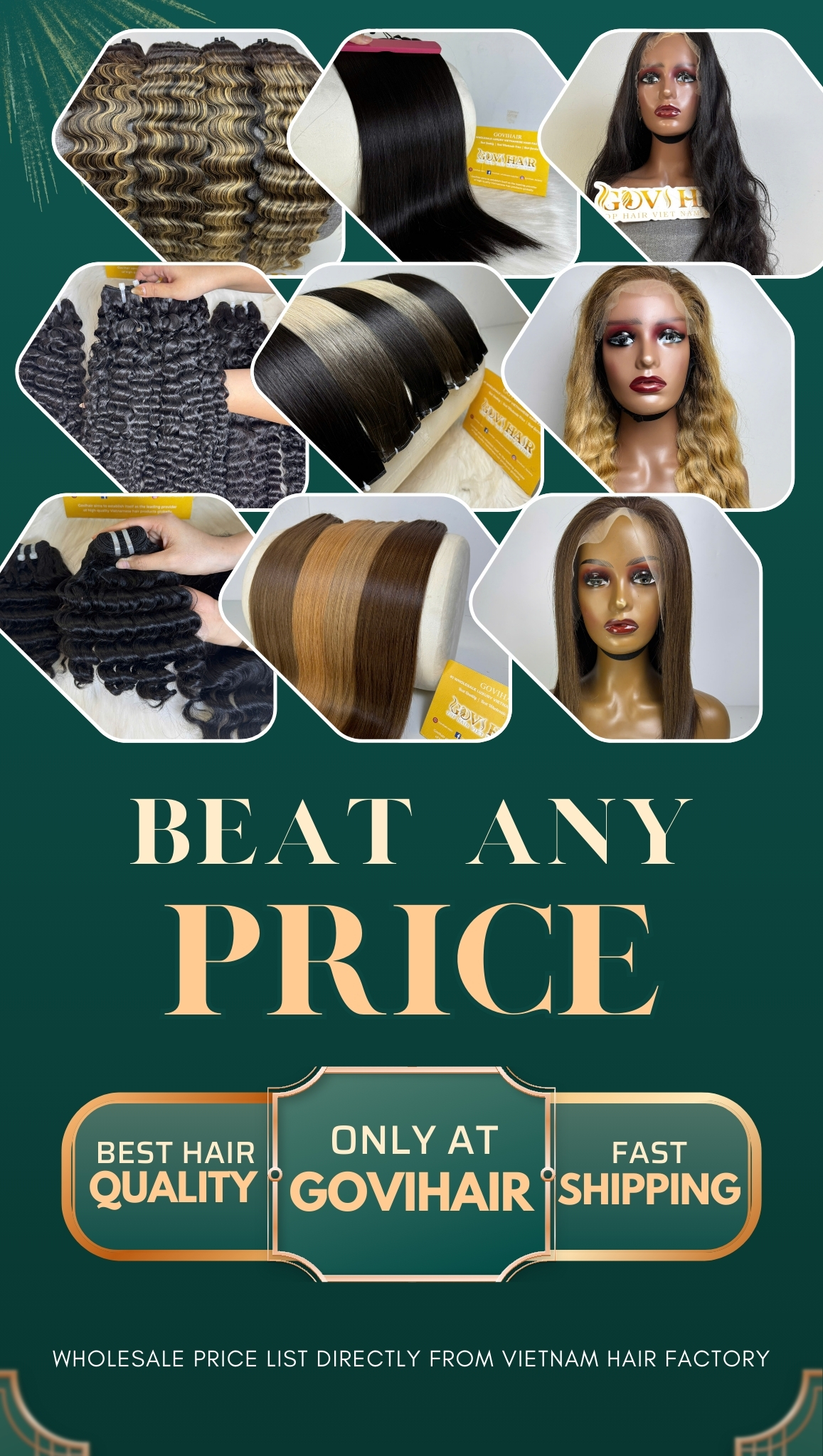

Wholesale Hair Vendors
Best Raw Vietnamese Hair Vendors 2026: A US Buyer’s Guide
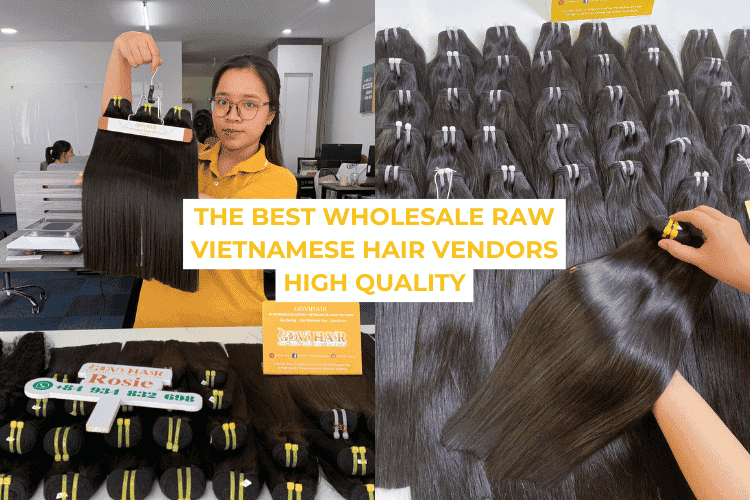
Jun
Every week we get the same message from US buyers — some version of this:
“Hello! I am interested in purchasing the raw curly hair bundles I saw in your photo. I have a few questions before ordering: Is this hair 100% raw and unprocessed? What is the origin of the hair? What lengths are available? What is the price per bundle? Do you have a matching lace frontal or closure? How long does shipping take? What payment methods do you accept?”
Seven questions. They are the right seven. This guide is a working shortlist of the best raw Vietnamese hair vendors — a vendor list you can act on, whether you need single bundles or vietnamese raw hair wholesale by the kilo.
It answers all seven questions up front, then compares the seven raw Vietnamese hair suppliers worth contacting in 2026 on the fields that actually decide a wholesale order: payment methods, in-stock inventory that ships immediately, hair origin, best-selling textures, and delivery time to the US. Many of these buyers are wig makers and wig vendors sourcing raw hair to build units — so there’s a full section on planning a wig order too.
Every price in this guide was quoted directly by Vietnamese hair vendors that run their own factory floor, not by trading agents reselling someone else’s stock.

Quick Answers: The 7 Questions Every US Buyer Asks
| # | Question | Short answer |
|---|---|---|
| 1 | Is the hair 100% raw and unprocessed (no steaming, no chemicals)? | True raw hair = zero chemical processing + naturally aligned cuticles. Donor count sets the tier (single-donor is the purest; raw also comes in 2–3 donor and mixed-donor tiers — see The 3 Types below). Steamed curls are not raw — steam-set textures are virgin hair, not raw. At Govihair, raw curly bundles are sold as their natural curl pattern; anything steam-processed is labelled virgin, not raw. |
| 2 | What is the origin of the hair? | Northern Vietnam highlands — single donors with long, uncolored hair. Each raw batch is traceable to its collection point. Ask any vendor to name the province, not just the country. |
| 3 | What lengths are available? | 8”–40” for raw Vietnamese hair bundles (see our bundle length chart). In-stock depth is best at 16”–24”; 30”+ is available but often produced to order. |
| 4 | What is the price per bundle? | Raw, 100g: $20–$35 (8”–16”), $35–$55 (18”–24”), $55–$90+ (26”–32”). Raw curly runs at the top of each band. Anything under $15/bundle sold as “raw single-donor” is not raw. |
| 5 | Is there a matching lace frontal or closure? | Yes — raw closures (4×4, 5×5) and frontals (13×4, 13×6) are cut from the same donor lot as the bundles so the curl pattern and density match. Always order the closure in the same order as the bundles, not later. |
| 6 | How long does shipping take? | In-stock: 2–3 days production + 3–5 days DHL/FedEx/UPS to the US. Custom textures/lengths: 5–7 days production. Total realistic door-to-door for a US buyer: 5–9 days. |
| 7 | What payment methods do you accept? | Bank transfer (SWIFT), Wise, Revolut · Western Union, MoneyGram, Ria · Remitly, TapTap · Lemfi, SendWave · USDT / Bitcoin. Structure: from 30% deposit to start production → video confirmation of your finished order on a scale → pay the balance in stages as you receive the goods. The video check is what protects you — never pay 100% upfront on a first order, on any payment rail. |
Raw Vietnamese Hair Vendors 2026 — Full Comparison Table
Six fields decide a wholesale raw hair order: price, factory scale, payment methods, in-stock inventory that ships immediately, the vendor’s strongest market, and the product category they’re actually built for.
The table below compares the four raw Vietnamese hair vendors most US premium buyers shortlist for raw Vietnamese hair bundles; three more strong factories — Lyn Hair, K-Hair, and 5S Hair — are profiled in full right after it. Treat the price column as a snapshot of wholesale raw hair prices and raw Vietnamese hair wholesale rates, not a final quote. (Specs as published by each vendor, July 2026. Confirm current terms before ordering.)
Mobile-friendly: this is a compact 4-vendor table. For Lyn Hair, K-Hair, and 5S Hair, see their full profiles below.
| Govihair | ApoHair | VinHair | YogHair | |
|---|---|---|---|---|
| Price / 100g bundle (raw) | $41.58–$60.28 (8”–16”) $67.98–$105.38 (18”–24”) $108.68–$124.08 (26”–30”) Reference pricesPremium | Bulk $12–$23 (6”–16”), $25.80–$39 (18”–24”), $45–$56 (26”–32”); tiers not publishedValue-to-mid | From ~$88/kg basic natural rawValue | Quote-only; colors above naturalsMid |
| Factory scale | Factory in Da Nang, single-donor network, N. Vietnam | 33,000 m², 1,000+ workers, 20 tons/mo — largest here. ISO 9001 + SA 8000 | ~1,000 m², ~100 workers, 10+ yrs | Bac Ninh, ~100 workers, 10+ yrs |
| Payment methods | 11 rails — widest here. SWIFT · Wise · Revolut · WU · MoneyGram · Ria · Remitly · TapTap · Lemfi · SendWave · USDT/BTC | T/T · card. Net 30 for accounts with history | T/T · WU | Bank transfer · WU |
| Deposit / payment terms | From 30% deposit to start production; pay the rest in stages as you receive the goods, with video confirmation before the final balance | Deposit + balance; deposit on custom orders (% negotiated) | 50–70% deposit typical | From 30% deposit; pay in stages during fulfilment |
| Transparency (paper trail) | Signed sales contract + commercial invoice by email, business registration, and video confirmation on a scale before final payment — full documented trail | Commercial invoice + quality & origin certificates per shipment; ISO 9001 + SA 8000; published legal entity | Registered factory / production license; invoice on request; warranty policy published | Business registration; commercial invoice on request; video check available |
| In stock / ships now | Naturals in stock — dispatch 2–3 days. Raw curly 16”–24” in stock; 26”+ made to order | Deepest in-stock. Dispatch 1–2 days; 500+ bags/day | In-stock naturals only. Slowest: 7–10 days | In-stock naturals + fast colors |
| Strongest market | US (CA, TX, GA), Europe, Nigeria, Ghana, SA | 50+ countries: US, UK, Canada, Brazil, Nigeria | US, Nigeria & Ghana, UK, Poland, Russia | Africa & emerging; also US, UK, CA, AU |
| Built for which product | Raw curly + matching raw closures/frontals from same donor lot. 8”–40”, DD & SDD, wigs, closures, frontals | Volume + OEM/private label. Bundles, tapes, tips, wefts, HD wigs. Free logo/tag | Plain naturals. Straight & wave bundles, bulk, weft | Raw + fashion colors in one order. 45+ colors |
| MOQ | 500g (≈5 bundles) | 200g — lowest published | ~1kg practical | Low, flexible |
| Shipping to US | 3–5 days DHL/FedEx/UPS | 3–4 days UPS/DHL/FedEx | 7–10 days incl. agent routes | 5–7 days |
Reading the table honestly: ApoHair wins on scale, MOQ and credit terms. Govihair wins on raw curly depth, payment flexibility and pre-payment video verification. VinHair wins on price and loses on speed. YogHair wins on color range. Of the three profiled below, Lyn Hair wins on low-MOQ startup accessibility, K-Hair on longevity and value #613, and 5S Hair on African-market dominance and heritage. No single vendor wins every column — match the column to your business, not the loudest homepage.
What the deposit tells you. Deposit terms are a trust signal, not just a payment detail. A vendor that asks for a low deposit — 30% rather than 70%, and never 100% upfront — is quietly telling you it has strong working capital, deep in-stock inventory, and an established track record: it doesn’t need your full payment to fund your order. Govihair and YogHair both start at 30% and let you pay the rest in stages as the order is verified and received. A vendor demanding 100% before production begins is the classic red flag — it means your money is funding the factory, and you have no leverage if the goods don’t match. Always check the deposit structure before you compare anything else.
Raw Vietnamese Hair Vendor Profiles — Strengths, Weaknesses & Who Each Fits
1. Govihair — best for raw curly + verified-before-payment ordering
Best for: Premium US and European wholesale buyers, salon brands, wig builders, and anyone buying raw curly who needs the curl pattern to be real.
Of all the raw Vietnamese hair vendors in this guide, Govihair is a direct manufacturer with its factory in Da Nang, sourcing raw hair from Northern Vietnam, from donors who keep long, uncolored hair using herbal washing practices and no chemical products.
Strengths – Video confirmation before the balance is paid. Before shipping, Govihair runs a live call showing the actual bundles from your order, each bundle on a scale confirming 100g, and the curl/alignment in real time. You approve, then you release the remaining balance. This closes the single most common raw-hair scam: swapping material after the deposit lands. – Raw curly is a core line, not an afterthought — Burmese curly, pixie curly, bouncy curly, deep wave, all natural pattern, plus matching closures and frontals cut from the same donor lot. – Broadest payment menu of the seven (11 rails) — SWIFT bank transfer, Wise, Revolut, Western Union, MoneyGram, Ria, Remitly, TapTap, Lemfi, SendWave, and USDT/Bitcoin. Wise and Revolut settle in 1–2 days at a fraction of wire fees; Lemfi and SendWave cover African corridors most factories can’t take money from at all. – Batch-level traceability from collection point to finished bundle. Supplies buyers across the US, Europe, Nigeria, Ghana, and South Africa.
Weaknesses / honest trade-offs – Card payments run through a secure payment link. If buyer protection on a first order matters most to you, what we offer is structural: you see video of your exact bundles on a scale before the second half of the money moves. – 500g MOQ is higher than ApoHair’s 200g — a 1–2 bundle test order isn’t possible. – Not the cheapest per bundle. Govihair prices at the raw single-donor band, not the value band. – Not built for 50kg+ industrial container runs the way ApoHair is.
Wholesale terms: 500g MOQ · from 30% production deposit, balance paid in stages · video confirmation before final payment · DHL/FedEx/UPS with tracking, 3–5 days to the US, 7–9 days to African markets via cargo agents.
Instagram : govihair_vietnamhair_factory

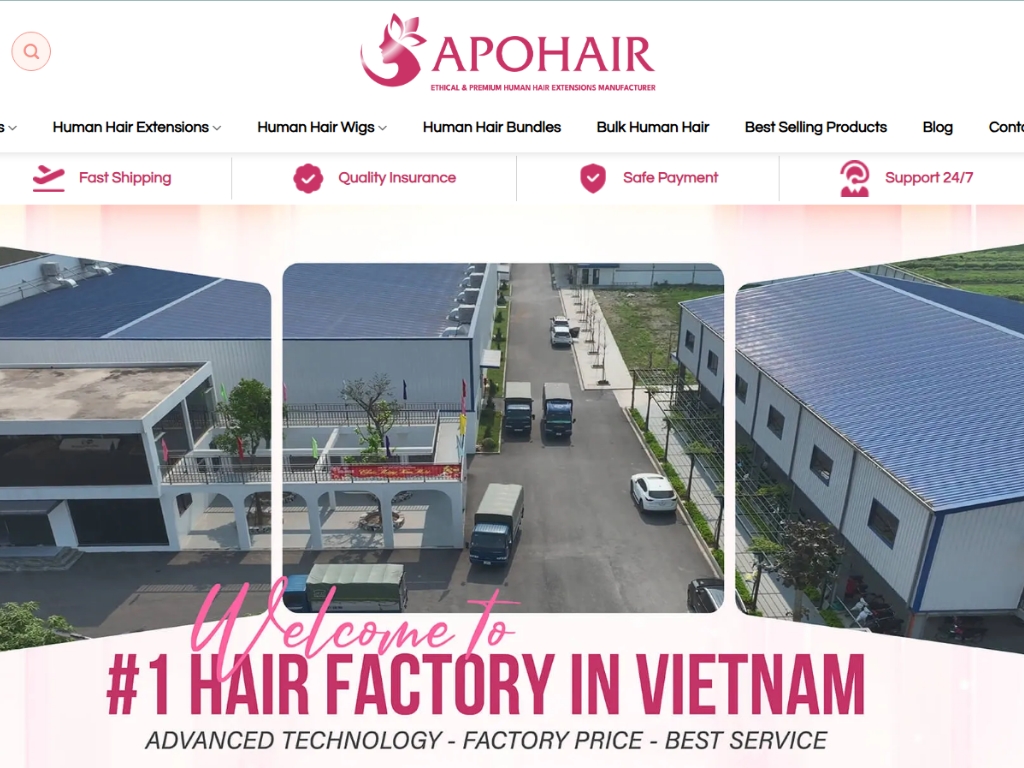
2. ApoHair — best for scale and OEM
Best for: High-volume distributors, private-label brands, buyers who need OEM/ODM at industrial scale.
33,000 m² facility, 1,000+ craftsmen, ISO 9001:2015 and SA 8000:2014 certified, monthly capacity around 20 tons — one of the largest in Vietnam.
Strengths – 200g MOQ, the lowest entry point among the major Vietnamese factories — cheap to test. – Net 30 terms available on accounts with order history: real working-capital relief that most Vietnamese factories don’t offer. – In-stock items dispatch in 1–2 business days; US/Canada in 3–4 days. – Certified (ISO + SA 8000) — useful if your own retail buyers ask about ethical sourcing documentation. – Product depth well beyond bundles: keratin tips, tape-ins, hand-tied wefts, HD lace wigs, closures.
Weaknesses – Wholesale tiers are not published — you negotiate, and a small buyer can end up paying near-retail without realizing it. – At 20 tons/month, raw single-donor is one line among many. Buyers who want deep raw curly inventory specifically often find the selection thinner than the catalog implies. – Big-factory service model: you are one account among thousands.
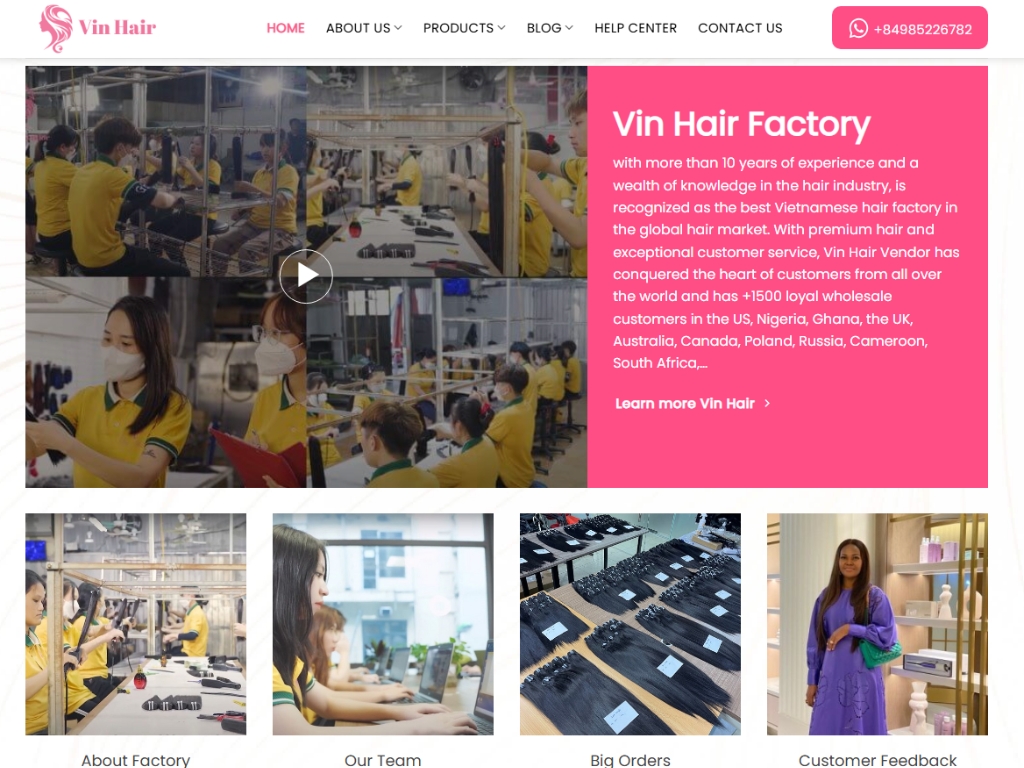
3. VinHair — best for value buyers who want plain naturals
Best for: Boutique salon owners and online sellers who want clean natural straight / natural wave and nothing complicated.
Strengths – Competitive direct-factory pricing at the value end of the Vietnamese market. – Narrow catalog, executed consistently — natural straight and natural wave with minimal processing. – Accepts Western Union, which matters for buyers with restricted banking access. – Published return/exchange window.
Weaknesses :
– Shipping is the slowest of the seven — 7–10 days is typical, and agent routes add variability. Not the vendor for a stylist who needs bundles for an install next week.
– No large-scale OEM/private-label capability; practical order range is roughly 1–10kg per product type.
– Thin on raw curly and custom color. If your customers want texture variety, you’ll need a second supplier.
4. Lyn Hair — best for startups and boutique brands testing before they scale
Best for: New hair brand founders, boutique owners, and small salons who want the lowest realistic entry point and per-brand customization before committing to volume.
Direct Vietnamese factory founded in 2010 (15+ years), led by CEO Ms. Emily. Sources single-donor raw hair from Vietnamese donors and supplies raw, Remy, and virgin lines — bundles, closures, frontals, wigs, and braiding hair — with customization on length, color, and packaging.
Strengths
– Lowest practical entry of the seven for a new brand — wholesale MOQ starts at 300g (3 bundles), and they’ll do a single-bundle sample exemption so you can test wash-and-bleach behavior before any bulk commitment. That de-risks a first order more than any other vendor here.
– Fast US shipping — 4–5 days, competitive with the quickest in this list.
– Customization for brand-builders — length (8”–30”+), texture, color, and private packaging, which suits boutique owners developing a branded product line.
– African-corridor payments — Bank transfer, Western Union, MoneyGram, Ria, and agent accounts remove the friction Nigerian/Ghanaian buyers hit with wire-only suppliers. – #613 bleaching supported on the raw line when processed properly.
Weaknesses
– Price list is kept private — quoted per order over WhatsApp and negotiable. You can’t see the tier structure up front the way ApoHair’s published 200g entry lets you.
– Broad catalog blurs the raw line — raw, Remy, and virgin sit side by side, so confirm in writing that a given SKU is genuine single-donor raw, not Remy, before you order.
– Not a raw-curly specialist — natural straight is the core texture; curly is available but this isn’t the lane Govihair owns.
5. YogHair — best for raw + fashion colors in one order
Best for: Trend-driven retail brands and distributors serving diverse markets.
Bac Ninh factory, ~100 workers, 10+ years, 1,500+ wholesale clients across the US, Nigeria, Ghana, UK, Australia, Canada, and South Africa.
Strengths
– 45+ colors — piano, balayage, ombre — alongside natural raw bundles, from one factory and one invoice. No second supplier relationship needed.
– Accessible MOQs on custom color.
– Strong fit for African and emerging markets where vibrant colors move alongside natural black inventory.
Weaknesses
– Breadth over depth: a catalog this wide means raw single-donor is not the whole business.
– Colored inventory moves fast; raw curly depth in longer lengths is less predictable.
Instagram : yoghair_vietnamhair_supplier
Website : Yoghair.com
6. K-Hair — best for value-priced raw naturals with reliable #613
Best for: Salon owners, brand founders, and importers who want single-donor raw naturals that bleach reliably to #613 at a lower price point, shipping to the US or Africa.
Hanoi-based direct factory with 30+ years of operation — one of the longest track records here. A 2,000 m² facility with 100+ workers, serving 5,000+ B2B clients across 50+ countries. Hair is sourced from donors aged 18–25 in northern Vietnamese highland provinces, with a 5-step QC process that rejects 15–20% of incoming raw bulk at sorting for cuticle or diameter inconsistency.
Strengths – Value pricing on raw naturals
— 100g raw bundles from $8.90 for shorter lengths, roughly $36–$59 for the popular 18”–24” range, with up to 50% off on bulk. Cheaper than Govihair on comparable naturals.
– Reliable #613 bleaching with strong batch consistency, backed by reject-at-sorting QC — useful when bundle #10 needs to match bundle #1.
– US warehouse stock shortens domestic delivery for buyers selling to US consumers.
– Payment rails cover African corridors
— bank transfer, WU, Remitly, Ria, plus NGN agent accounts.
Weaknesses
– MOQ and full pricing aren’t fully published— bulk pricing on request. A small buyer can’t see the tier structure the way ApoHair’s 200g entry makes clear.
– Not a raw-curly specialist — strong on naturals and #613; natural-pattern curly isn’t the lane.
– The US-warehouse convenience is a step removed from cut-to-order single donor — confirm whether a given SKU is warehouse stock or fresh factory production if traceability matters to your brand.
7. 5S Hair — best for the African market and heritage buyers
Best for: Distributors and resellers serving Nigeria, Ghana, and wider Africa who want value naturals from a long-established factory with local shipping infrastructure.
Positioned as Vietnam’s first hair factory, operating since 1989 — the longest heritage of any vendor here. Headquartered in Hanoi with branches in the US and Nigeria (since 2018), producing 2,000+ kg/month, and winner of the Top Vietnamese Brand Award in 2021.
Strengths – Dominant in Africa — the company reports that around 80% of Nigerian resellers source from them. If your market is Nigeria/Ghana, this is deep, proven distribution.
– Payment and logistics built for African buyers — Naira accounts, a dedicated Nigeria shipping agent at a fixed $8–10/kg (customs included), plus Zelle, World Remit, Remitly, Onepay, and more. The Onepay (Visa/Mastercard) route even carries a refund policy for faulty orders.
– Heritage + awards as trust signals, and video-call order verification before shipping.
– Value pricing — raw bundles from around $8.8 per 100g at 8”, with tiered bulk discounts ($5–$50/kg off by volume).
Weaknesses
– Agent-route shipping is slow — this is the single most consistent independent critique of 5S. The DHL/FedEx priority option is faster but costs more.
– Africa-first orientation — payment, logistics, and product mix are optimized for volume African distribution, not premium US salon positioning or raw-curly specialization. – Product focus is value naturals (weft, bulk, extensions); not the vendor for boutique raw curly or same-lot closure/frontal matching.
Contact: WhatsApp +84 855 555 754
Which Vendor Fits Your Business Type?
A dropshipper and a hair company need opposite things from a supplier. Not all raw Vietnamese hair vendors fit every business, so match your model to the column, not the marketing.
| Your business | What you actually need | Best fit | What to order |
|---|---|---|---|
| Personal use | 1–2 bundles, no MOQ headache, fast delivery, buyer protection on payment | Any vendor’s retail line — but expect to pay near-retail. Buying 5 bundles at wholesale often costs less per bundle than 2 at retail | 1 texture, 18”–22”, + matching closure |
| Start business / new retail brand | Lowest possible MOQ, low cash risk, a payment rail with low fees, one texture to prove the market before scaling | ApoHair (200g MOQ) to test cheaply · Govihair (500g) if you’re positioning premium from day one — pay the deposit via Wise or Revolut to keep fees near zero | 1 best-seller texture, 3 lengths (16/20/24”), + 1 closure. Don’t buy 6 textures on order one |
| Dropshipping | Ship-now inventory, no held stock, fast dispatch, consistent restock, unbranded packaging | ApoHair (1–2 day dispatch, deepest in-stock) · Govihair for premium raw curly dropship | Only in-stock textures. Never dropship a made-to-order length — the 7-day production kills your delivery promise |
| Hairdresser / independent stylist | Small quantities, reliable texture match on reorder, hair that survives client color work | Govihair — single-donor consistency means bundle #2 matches bundle #1 six months later | 500g in your two most-requested textures + closure. Raw, because your clients bleach |
| Salon / salon owner | Predictable reorders, hair that bleaches to #613 without snapping, matching closures/frontals, no client complaints | Govihair (raw + same-lot closures + video verification) · Lyn Hair if you want a lower 300g entry to test before committing to a standing order | 1kg standing order in 2 textures, 18”–24”, + 13×4 frontals. Set a 6-week reorder cycle |
| Beauty spa / medical spa (extension services) | Premium positioning, ethical sourcing you can document to clients, longevity (fewer redo appointments) | Govihair — traceable single-donor sourcing you can show the client · ApoHair if the client asks for ISO/SA 8000 paperwork | Raw straight & body wave, tape-ins/keratin tips for non-damaging installs |
| Wig shop / wig maker | Bulk hair (unwefted), super double drawn density, long lengths, curl patterns that hold | Govihair (raw curly, super double drawn, 8”–40”) · ApoHair (bulk braiding hair, HD lace) | Bulk/loose hair + lace closures. Super double drawn for ventilated units |
| Hair shop / wholesaler | In-stock depth across textures, fast restock, volume pricing, tracked shipping | ApoHair (20 tons/month, 1–2 day dispatch) · YogHair if your customers want fashion colors | Mixed-texture pallets. Keep a floor of 5–10kg on your top 3 sellers |
| Hair company / distributor | OEM/private label, custom packaging, 50kg+ runs, credit terms | ApoHair (OEM/ODM, free logo & tag design, Net 30) | Private-label runs from 500+ units. Negotiate tiered pricing before the first PO |
One rule across every category: whatever your business type, the first order is a test order. 500g, run your own cuticle/elasticity/burn tests, put it through a full wash cycle, then scale.
>> Read more: buying for the UK instead of the US? Our guide to hair vendors in UK compares 10 suppliers on trade accounts, MOQ, import VAT and delivery.
What “Raw” Actually Means — How to Tell It’s Real, What Vendors Must Clarify, and Common Questions
We’ve spent close to twenty years collecting, sorting, and shipping raw Vietnamese hair — and the question we hear more than any other from US buyers is a fair one: hundreds of vendors all say “raw,” so how do you tell if hair is really raw, and how do you know the hair someone ships you is the real thing?
Here’s the honest answer we give, as people who handle it every day. No industry body enforces the word “raw,” so you shouldn’t take anyone’s word for it — ours included. Verify it yourself on a sample. Below is exactly how we’d check whether a bundle is genuinely unprocessed Vietnamese hair, single-donor or otherwise, the points any honest vendor should be willing to clarify, and the questions we get asked most.
The one non-negotiable: raw hair is completely unprocessed — no chemicals, cuticle intact. Everything below is how you confirm that with your own eyes and hands.
How to tell it’s really raw — the checks you run yourself
- Scrape the cuticle with a blade. Lay a strand flat, scrape it lengthwise, and read the color of the residue that lifts off: pure white, like a human cuticle scale, means 100% genuine raw, top quality; white tinged with yellow means human hair that’s been bleached or dyed — that’s virgin, not raw; black means a synthetic fiber. (Full method in How to Verify below.)
- Test the bleach lift. Genuine raw takes color predictably, working up from darker tones — #2, #4, and lighter — and the top single-donor and baby-donor tiers lift all the way to #613 and platinum when a skilled colorist and good bleaching technique do the work. Processed hair snaps or lifts unevenly; synthetic melts. How high it lifts cleanly is one of the clearest signs of a real, undamaged cortex.
- Rub, soak, and tangle-test. Rub the bundle firmly in your hands, dunk it in water, and run it through a hand paddle or an industrial tangle machine. Genuine raw stays smooth and separates cleanly; synthetic fibers and stripped “raw” mat, knot, and shed — and this process actually pulls the bad strands out so you can see and remove them.
What a raw hair vendor must clarify — before you trust the label
Ask for each of these, and get the answer in writing on WhatsApp. A vendor who answers all of them plainly is selling raw; one who dodges is selling a label.
- Donor tier. Single-donor, 2–3 donor, or mixed-donor? Each is genuinely raw but priced and graded differently (see The 3 Types below).
- Natural or steam-set. Especially for curly — is the pattern natural or steamed? Ask for a video of the bundle washed and air-dried with no product.
- Chemical-free proof. Confirm no acid, silicone, bleach, or dye — and that they’ll allow a burn test and scrape test on a sample.
- Origin and traceability. Which region or province the hair was collected in, and whether each batch traces to its collection point.
- Grade and same-length ratio. Double, super, or luxury — and the actual same-length percentage (see Hair Grades below).
- Natural color. Confirm the color is the hair’s natural tone, not dyed to look uniform.
- Same-lot closures and frontals. Whether the closure/frontal is cut from the same donor lot as the bundles, so the match holds.
Where buyers get misled: steaming
A large share of “raw curly” bundles on the market are straight Vietnamese hair that has been steam-set into a curl pattern. Steam is not a chemical, so vendors argue it still counts as raw. It does not. Steam-set curls relax over 6–12 months and revert toward the hair’s original pattern. Genuine raw curly hair grew curly. That is why it costs more, why supply is limited, and why the curl still snaps back after 30 washes. If you are buying raw curly, ask one question: “Is this curl natural or steam-set?” — and get the answer in writing.
The other common fraud: floor hair
Collected from hairbrushes and salon floors, mixed from many donors and many directions, acid-washed to strip and realign cuticles, then silicone-coated to feel soft. It behaves like raw hair for 2–4 weeks. Then it mats. The cuticle slide test, elasticity test, burn test, and scrape test catch it reliably.
Quick answers on “raw”
- Is raw hair always natural black? It’s a natural dark tone (deep brown to black), never dyed. If a bundle is a uniform jet black or any fashion color and sold as “raw,” it’s been processed.
- Does raw hair tangle? Not when cared for — aligned cuticles resist matting. Early tangling is a red flag that the cuticle was stripped and the hair isn’t raw.
- Why does my “straight” raw still have a slight wave? Because it’s natural. Real raw hair carries the donor’s natural movement; perfectly poker-straight hair is usually steamed or ironed.
- Can raw hair be colored? Yes — that’s the point. It lifts and takes color better than processed hair. But once you or a colorist dyes it, it’s no longer raw; it becomes color-treated hair.
The 3 Types of Raw Vietnamese Hair — and How to Pick the Right One
All three types below are genuine raw hair: unprocessed, no chemicals, cuticle intact. What separates them is donor sourcing, which drives the price, how evenly the hair takes bleach, and how long it lasts. Match the type to your market rather than defaulting to the most expensive one.
Type 1 — Single-donor (donor & baby hair). The rarest and most beautiful tier, collected from a single donor, and the most expensive. Because every strand grew from one head, it takes bleach to the lightest, most even platinum of any raw hair, and it lasts the longest — 3 to 5 years. It includes more short “baby” hairs, so the ends carry natural fullness. No chemicals, ever. This is the tier for premium salon color work and clients who want maximum longevity.
Type 2 — Two-to-three-donor raw. Collected from two or three donors: still fully unprocessed and still bleachable, but supply is far deeper — enough to serve real wholesale volume — so the price is more competitive. It’s beautiful, unprocessed, and a favorite of wholesale importers for exactly that balance. The trade-off: bleach evenness is a step below single-donor and baby hair, and lifespan runs 2 to 3 years. The workhorse tier for most wholesale programs.
Type 3 — Mixed-donor raw. Never chemically processed, hand-selected strand by strand, and blended from multiple donors. It still bleaches, though color evenness is below the first two tiers. Its advantages: the fullest, thickest ends of the three, and the most competitive price of the raw tiers. Best where buyers want raw quality and thick ends at the lowest raw entry point, and don’t need flawless platinum lifts.
Quick rule: for platinum color and 3–5 year longevity, order Type 1. For the best balance of price, supply, and quality at volume, order Type 2. For thick ends and the lowest raw price, order Type 3. Whichever you choose, confirm it’s unprocessed and ask the vendor to state the donor tier in writing.

Hair Grades Explained: Double vs Super vs Luxury (and Why China’s “A++” Isn’t Vietnam’s)
Before you compare prices across raw Vietnamese hair vendors, understand grade — because grade, not just length, is what you’re paying for, and it’s where vendors quietly cut corners. For the full breakdown, see our hair grade chart guide. A raw hair grade is defined by two things: how much of the bundle is the same length (the “same-length ratio”), and how short the shortest strands are. The higher the ratio and the fewer short strands, the blunter and fuller the ends, and the more raw material and hand-sorting it took to make.
Here is how the Vietnamese grades actually break down:
- Double drawn — the standard full grade. Short strands removed so the bundle stays reasonably thick from root to tip.
- Super (super double drawn) — ~80% same length, no strands under 12”, and about 90% of the hair is 18” or longer. Noticeably blunter, fuller ends.
- Luxury — ~90% same length, no strands under 14”, and about 90% of the hair is 20” or longer. The fullest, most uniform grade — for a 24” bundle, roughly 90% of the strands actually reach that length instead of thinning out toward the tip.
Why this matters: two bundles can both say “24 inch” and “raw” and cost very differently, because one is single drawn (thin, tapering ends) and one is Luxury (blunt, full ends). Always ask a vendor to state the grade and the same-length ratio in writing before you order — and before you compare prices across raw hair vendors. A cheap “24-inch raw” bundle with no grade stated is usually single drawn with heavy tapering.
Vietnam vs China grades are not the same scale. Chinese suppliers use an “A” grade system that does not map one-to-one to Vietnamese grades:
| China grade | Vietnam equivalent |
|---|---|
| A++ | Luxury |
| A+ | Super |
| A | Double |
And there’s a quality gap underneath the labels: Chinese hair generally carries a higher proportion of short strands than Vietnamese hair at the equivalent grade, which is why it thins out and tangles faster over time. So “A++” from a Chinese factory and “Luxury” from a Vietnamese factory are marketed as equivalent, but the Vietnamese bundle typically holds fuller ends through more washes. When you compare quotes across countries, compare the same-length ratio, not the letter or word on the label.
The Bigger Raw Hair Market: Origin-by-Origin Strengths and Weaknesses
Vietnam is not the only raw hair origin, and raw Vietnamese hair vendors are not your only option. Before you commit, here is the honest picture of what else is on the table — and where each one breaks down.
Here’s how published wholesale prices actually stack up, per 100g for a 20-inch natural straight bundle. The myth that some origins are “cheap” rarely survives a side-by-side:
| Origin | Wholesale price (per 100g, 20”) | The number in plain English |
|---|---|---|
| Vietnam (raw) | ~$45–75 | Genuine raw quality at the best price-to-quality ratio |
| China (factory) | ~$48–54 | Essentially the same as Vietnam — not cheaper |
| India (temple) | ~$20–40 | Lowest sticker price; quality swings hard batch to batch |
| Cambodia | ~$40–90 | Coarser texture, but scarcer supply pushes prices up |
| Russia (premium donor) | ~$300–430 | Luxury tier — roughly 4–5× Vietnam for the same length |
Ranges reflect publicly listed factory wholesale prices; your exact quote depends on grade, texture, and order size. Below, we break down what each origin is actually good for.
Raw Cambodian hair
Strengths: Coarser, denser shaft; blends beautifully with relaxed 4C and natural 3A–4B hair; holds a curl without steam-setting; excellent volume.
Weaknesses: Supply is the constraint. Cambodia’s population is roughly one-sixth of Vietnam’s, the collection infrastructure is smaller, and there are few full-scale factories — so much of the raw material is exported to Chinese factories for production.
Result: higher prices for the same grade (a 12” double-drawn Cambodian bundle commonly runs $40–$50 vs roughly $23 for the Vietnamese equivalent), more batch-to-batch variability, and harder bleaching to #613.
Buy it if: your clients want volume and coarse texture, and you can absorb inconsistent supply.
Raw Indian (temple) hair
Strengths: Enormous volume, long-established temple donation supply, aggressive pricing, naturally wavy patterns.
Weaknesses: Donor diversity is huge, so quality swings hard between lots. A great deal of temple hair is chemically standardized after collection to unify texture and color — which weakens the fiber and quietly disqualifies it from being “raw.” Ends often thin out. Lifespan is typically shorter than Vietnamese raw.
Buy it if: you compete on price and your customers replace hair every 6–12 months anyway.
Raw Burmese hair
Strengths: The luxury curly texture the US market chases; genuinely rare; commands the highest retail prices.
Weaknesses: Rarity is the problem. Real Burmese raw supply cannot fill wholesale demand — which means a large proportion of what is sold as “Burmese curly” worldwide is Vietnamese or Chinese hair steam-set to imitate the pattern. Verification is very hard. Lead times and prices are unpredictable.
Buy it if: you have a verified source and a client base that pays luxury pricing. Otherwise, buy genuine raw Vietnamese curly and label it honestly.
“Brazilian” / “Peruvian” / “Malaysian” labelled hair
Strengths: Familiar marketing terms US consumers already search for. Cheap and abundant.
Weaknesses: These are texture labels, not origins, in most of the market. The overwhelming majority is processed hair from Asian factories. Most commercially available “Brazilian” hair degrades noticeably within 3–6 months — the single most common complaint in wholesale buyer reviews, and the reason experienced buyers have shifted toward origin-verified raw.
Buy it if: you are a volume retailer competing on price, with clear expectations set.
Chinese factory hair (Xuchang and similar)
Strengths: Unbeatable manufacturing infrastructure, the widest wig/lace product range on earth, fast turnaround, low cost, deep in-stock inventory, and many hold US warehouse stock for 1–3 day domestic delivery.
Weaknesses: The raw material is usually imported — from India, Cambodia, Myanmar, or Vietnam — then processed at scale. “Raw single-donor” claims from a factory that buys its bulk hair on the open market are structurally hard to verify. Heavy processing (acid + silicone) is common at the lower price tiers. And on price, the “cheaper” reputation doesn’t hold: a Chinese factory quote for a 20-inch straight bundle runs about $48–54 per 100g — the same band as Vietnam, and sometimes higher.
Buy it if: you need wig construction volume and US-warehouse speed more than you need cuticle integrity.
US-based raw hair boutiques
Strengths: Domestic shipping in 1–3 days, no customs, easy returns, English-language support in your time zone.
Weaknesses: They are resellers, not factories. Expect a 20–40% markup over factory cost — on a 50-bundle order that’s $400–$600 straight out of your margin — and they cannot answer the origin question with certainty, because they bought from a factory too.
Buy it if: speed and convenience beat margin for your business model.
Why US Buyers Choose Vietnamese Raw Hair Vendors
Put plainly: Vietnam is the only origin that combines genuine raw quality with a supply chain deep enough to scale on — which is why so many buyers work with raw Vietnamese hair vendors. Ordering direct from a raw hair factory in Vietnam is what makes the difference below possible.
- The raw material is domestic, not imported. Vietnamese factories sit inside the collection region. They aren’t buying bulk hair on an open market and calling it single-donor — they’re collecting it. That is what makes traceability a real claim rather than a marketing line.
- It bleaches to #613 reliably. Because the cortex has never been weakened by industrial chemicals, raw Vietnamese hair lifts to platinum without snapping. For a salon doing color transformations, that turns color services from risk management into routine work — and opens up custom blondes, piano highlights, and ombre pieces as a product category.
- Quality-to-price is the best in the market. Vietnamese raw hair costs less than Cambodian and Burmese for a comparable single-donor grade — not because it’s inferior, but because supply is deeper and labor infrastructure is mature. You get raw performance without paying the scarcity premium.
- Lifespan protects your reorder rate. Well-maintained raw Vietnamese hair runs 2–5 years. Hair that lasts doesn’t generate returns, doesn’t generate complaints, and generates repeat installs. One salon client on raw Vietnamese hair is worth more long-term than three clients cycling through cheap bundles.
- Payment flexibility is built for international buyers. Wise and Revolut for low-fee transfers from the US and EU. SWIFT for volume. Western Union, MoneyGram, Ria, Remitly, TapTap, Lemfi and SendWave for buyers in restricted-banking markets — Nigeria, Ghana, South Africa — where most Chinese and Indian suppliers simply say “wire only” and lose the order. USDT/Bitcoin for buyers who want to settle same-day across borders. Eleven rails, one invoice.
- Speed to the US is competitive. Vietnamese factory → DHL/FedEx/UPS → your door in 3–5 days on in-stock items. The only thing faster is a US reseller charging you a 30% markup.
- Ethical sourcing you can actually document. Donors are paid, voluntary, and identifiable. When your own retail customers ask where the hair came from — and in the US market in 2026, they do — you can answer.
How to Plan a Wig Order: A Guide for Wig Vendors (Products, Order List, Budget & Quantity)
If you build or sell wigs, a raw hair order takes a little planning — you’re not just buying bundles, you’re buying the right combination of bundles and a lace piece, in the right lengths and quantities, to make finished units. Govihair supplies wig makers and Vietnamese wig vendors worldwide, and like the best raw Vietnamese hair vendors it sells the bundles and lace pieces together, so this is a practical playbook: plan it well and nothing arrives short. Here’s how.
The products: what goes into a wig
A wig is bundles (wefted hair) + one lace piece that recreates the scalp or hairline. Three common builds:
- Closure wig — a small lace square (4×4, 5×5, 6×6) or strip (2×4, 2×6) at the part. The most economical build.
- Frontal wig — a 13×4 or 13×6 lace frontal across the whole hairline, ear to ear. More natural, far more styling freedom.
- Full lace wig — lace across the entire cap; the most natural and the most hair-intensive.
Lace, matched to your market: Transparent lace (brown, blends with deeper skin tones — strong for African buyers), HD lace (soft, near-invisible — favored in the US, Europe, and West Asia), and HD Swiss (melts into the scalp for the most undetectable finish).
Parting: closures come Middle, Free, Kim K, or Three part; frontals (13×4, 13×6) are free-part.
Quality tiers (entry → premium): Raw Donor (single-donor), Raw Swiss Lace, Remy Double Drawn, Remy Super Double Drawn, Remy Luxury — higher tiers give fuller, blunter ends and more even bleaching (see Hair Grades above).
Govihair signature: the 2-in-1 wig set — one wig built to wear two ways — gets more value out of a single unit, which is useful if you’re selling to retail customers who want versatility.
Quantity: how much hair each wig needs
The quick rule: under 16” ≈ 2 bundles; over 16” ≈ 3 bundles (our how-many-bundles-for-a-sew-in guide and wig length chart go deeper). But the base changes it — a small closure covers little of the cap, so it needs more bundles to fill it; a frontal covers the whole hairline, so it needs fewer. Use this guide:
Base Length Bundles needed Closure / frontal length Closure 2×4 / 2×6 (small) 8” 1.5 bundles 2” longer than bundles 10–20” 2.5 bundles 2” longer 22” 3 bundles 22” 24–28” 3 bundles 26” Closure 4×4 / 5×5 / 6×6 8” 1.5 bundles 2” longer 10–20” 2 bundles 2” longer 22” 2 bundles 22” 24–28” 2 bundles 26” Frontal 13×4 / 13×6 8–12” 1 bundle 2” longer 14–20” 1.5 bundles* 2” longer 22–24” 1.5 bundles same length 26–28” 2 bundles 24” *For a 14–20” frontal wig, that’s one full-length bundle plus one shorter bundle for root volume.
Two things to notice: the small 2×4 / 2×6 closures always need the most hair, because the lace fills so little of the cap; frontals need the least. And the closure or frontal is usually cut 2 inches longer than the bundles so it can be trimmed and blended into a seamless finish.
The order list: plan per unit, then total
Plan each finished wig as its own line, then add them up. A clean order list looks like this:
Unit Texture Base Length Bundles Closure / frontal Wig 1 Raw straight 4×4 closure 20” 2 × 20” 1 × 22” closure Wig 2 Raw body wave 13×4 frontal 24” 1.5 × 24” 1 × 24” frontal Wig 3 Raw curly 5×5 closure 18” 2 × 18” 1 × 20” closure Totalled, that’s your bundle count, your closure/frontal count, and your order weight for shipping — everything a vendor needs to quote you accurately in one message.
Closure prices (natural color)
Closure price scales with size, length, and texture. Here are Govihair’s raw hair HD lace closure reference prices (natural black, USD each; wavy, curly, and bone-straight run a few dollars above straight; add $6.60 for a dark color):
Length 2×4 (20g) 2×6 (27g) 4×4 (30g) 5×5 (40g) 6×6 (60g) 8” $31.79 $36.19 $43.89 $55.99 $65.89 12” $36.19 $41.69 $52.69 $63.69 $77.99 16” $41.69 $48.29 $58.19 $73.59 $87.89 20” $48.29 $54.89 $65.89 $84.59 $99.99 22” $50.49 $58.19 $69.19 $99.99 $110.99 24” $52.69 $65.89 $77.99 $107.69 $117.48 26”–28” $54.89–$55.99 $70.29–$72.49 $83.49–$88.99 — — For your wholesale price, chat with Tommy on WhatsApp (+84 795 746 986).
Straight prices shown; 5×5 and 6×6 are available up to 24”. Frontal (13×4, 13×6) pricing is quoted separately — ask your rep.The budget: cost per wig
Cost per wig = (bundles × price per bundle) + closure/frontal price + wig-making fee + a share of shipping. Govihair’s wig-making (sewing) fee is $25 per set. A worked example — one 20” 4×4 closure wig in raw straight:
- 2 bundles × 20” (raw, ~$45 each in the 18–24” band) = ~$90
- 1 × 4×4 closure, 22”, straight (natural color) = $53.90
- Wig-making fee = $25
- Shipping share — a 1 kg order (~10 bundles) to the US runs about $45 total, so a couple of bundles’ plus a closure is only a few dollars each (see Shipping Cost below)
So the hair + closure + sewing for a single 20” closure wig lands around $169, plus a small shipping share. Build several units into one order — when you buy raw hair in bulk, the per-wig shipping drops sharply, which is one reason wholesale buyers consolidate with a single raw Vietnamese hair vendor.
Planning tip: decide your unit mix first (how many closure vs frontal wigs, which lengths and textures), build the order list above, then ask for one consolidated quote that includes closures/frontals and the $25/set sewing fee. That gives you a true per-wig landed cost before you commit a deposit.
How Much Does Shipping Raw Hair to the US Cost?
Raw hair is light, so freight is priced by weight — and since a bundle is 100g, 1 kg ≈ 10 bundles. Shipping is a core part of buying raw hair wholesale to the USA, so here’s a realistic estimate for express air freight (DHL / FedEx / UPS) from Vietnam to the US, delivered door-to-door in 3–5 days:
Order weight ≈ bundles Est. shipping to US 0.5 kg ~5 (the 500g MOQ) ~$42 1 kg ~10 ~$45 2 kg ~20 ~$62 3 kg ~30 ~$78 5 kg ~50 ~$110 Two things worth noticing. First, freight barely moves between 0.5 kg and 1 kg — so consolidating into a bigger order costs almost nothing extra in shipping and drops your freight cost per bundle sharply.
Second, these are freight-only estimates at current exchange rates; they exclude peak-season surcharges and US import duty. Duty depends on your order’s declared value and current US customs rules — you can check the current rate for human hair in the US Harmonized Tariff Schedule — so factor it into your landed cost and ask us for an exact quote before you pay.
The Paperwork That Protects Your Money — and Can Cut Your Tax Bill
Most raw hair guides stop at “check the hair.” The step that actually protects the money is paperwork — and it’s the one buyers skip most often. Before you send a deposit to any of the raw Vietnamese hair vendors you’re considering, get a signed sales contract and a commercial invoice, emailed to you. This is the single most effective defense against the classic online-sourcing scam, and in high-tax countries it can also put money back in your pocket at tax time.
What a legitimate commercial invoice must contain. A real invoice is not a screenshot of a price in a chat. It shows the vendor’s registered company name, business address, and tax ID, an itemized list of exactly what you ordered (texture, length, grade, quantity, unit price), the total, and the bank account in the legal entity’s name — which must match the company on the invoice. A sales contract adds the agreed terms: deposit, balance schedule, production time, and what happens if the goods don’t match.
Why this defeats the “pay-and-vanish” scam. The most common way buyers lose money sourcing hair online isn’t bad quality — it’s a fake “vendor” who takes a deposit and disappears. A scammer operating without a legal entity cannot put a registered company name and tax ID on a document, because that document can be traced. Requiring a contract and invoice forces the seller to prove a legal identity before your money moves. A genuine factory issues both without hesitation; a fraud stalls, deflects, or refuses. That reaction alone tells you everything, and this one step removes almost all of the online-fraud risk.
Why it can also lower your taxes. In high-tax markets — the US, much of Europe, and parts of Western Asia — a commercial invoice is the document your accountant uses to record the purchase as a business cost of goods, which is deductible against personal or corporate income tax. In other words, the same document that proves the vendor is real also helps reduce your taxable profit. How much and how it applies depends on your country and business structure, so ask your accountant — but you can only claim it if you actually have the invoice, which is one more reason to insist on it up front.
What Govihair provides. Every Govihair wholesale order comes with a signed sales contract and a commercial invoice by email showing the registered legal entity, tax ID, and itemized order — plus video confirmation of your finished bundles on a scale before you pay the final balance. Transparent paperwork and video verification are two different protections, and Govihair gives you both.
How to Verify Any Raw Hair Vendor Before You Send Money
Verification happens in two stages: the paperwork checks you do before you pay a cent, and the physical hair tests you run after your sample arrives. This is how to buy raw hair from Vietnam safely — and how you separate legit raw Vietnamese hair vendors from the fakes. Start with the paperwork — it’s what protects your money.
Start here — get the sales contract and commercial invoice by email. Before any money moves, require the vendor to email you a signed sales contract and a proper commercial invoice — showing the registered company name, address, tax ID, and an itemized list of your order. Treat this as mandatory, not optional. It does four things at once:
- – It proves the seller is transparent and real. A genuine factory with a legal entity issues contracts and invoices as a matter of course. A scammer planning to take a deposit and disappear can’t — or won’t — put their legal identity on a document.
- – It confirms real business registration and legal standing, which removes the classic online-fraud scenario where the “vendor” vanishes after payment and leaves you with no money and no goods.
- – It keeps your money safe. A contract in writing gives you documented terms — what you ordered, at what price, on what timeline — that you can act on if anything goes wrong.
- – It can save you money at tax time. In high-tax markets like the US, much of Europe, and parts of Western Asia, a commercial invoice is exactly the document your accountant needs to deduct the purchase as a business cost of goods against personal or corporate income tax. Ask your accountant how it applies to you.A vendor who hesitates to email a contract and invoice is telling you something. Walk away — that one step alone removes almost all of the “pay online and get scammed” risk.Business registration cross-check. Request the Vietnamese Business Registration Certificate and confirm it matches the company name on the invoice. The bank account you send money to must match the legal entity name exactly.The live video call. Before any deposit, schedule a WhatsApp or FaceTime call during Vietnam business hours. Ask to see: the raw bulk stock, workers on the production floor, and a piece of paper with your business name held next to the hair. Factories have floors to show. Middlemen don’t.Once your sample arrives, run the physical tests:
The curl-origin question (for raw curly). Ask: “Is this curl natural or steam-set?” Then ask for a video of the bundle being washed and air-dried with no product. A natural curl pattern comes back on its own. A steam-set one doesn’t.
The cuticle slide test. Slide fingers root-to-tip: smooth. Tip-to-root: you should feel friction, like fine scales. Identical both ways = acid-stripped cuticles = it will tangle after washing.
The elasticity test. Wet one strand, pull gently from both ends. Raw hair stretches slightly and snaps back. If it stays stretched or breaks with no give, the protein structure is chemically damaged.
The burn test. Snip a small section, hold with tweezers, ignite. Raw human hair burns with a clear flame, smells like singed protein, and leaves grey-white ash that crumbles. Synthetic or silicone-coated hair melts, smells like plastic, and leaves hard black beads. Even a few hard beads means synthetic filler.
The scrape test (the fastest raw-vs-not check). When several vendors all claim “raw,” this one test separates them. Lay a strand flat and gently scrape it lengthwise with a razor or blade, against the cuticle, and look at the color of the fine residue that lifts off:
- – Pure white, like the scale layer on a human hair — this is 100% genuine raw, top quality. The cuticle is untouched.
- – White tinged with yellow — the hair is human but has been bleached or dyed. It is no longer raw; this is virgin (chemically-lightened) hair being sold as raw.
- – Black comes off — the “hair” is synthetic. A real human cuticle never scrapes off black; a black residue is dye or coating on an artificial fiber.Do this on the sample before you commit to volume. It takes seconds, needs no fire, and it’s the clearest way to catch bleached hair or synthetic fiber wearing a “raw” label.
FAQs — Answered for US Wholesale Buyers
Is your raw curly hair 100% raw and unprocessed — no steaming, no chemicals? Yes. Govihair raw curly bundles — Burmese curly, pixie curly, bouncy curly — are sold in their natural curl pattern, with no acid bath, no silicone coating, no dye, and no steam-setting. The cuticle is intact and root-to-tip aligned. If a texture in our catalog is steam-set, it’s labelled virgin, not raw. We’ll send video of the bundle washed and air-dried before you pay the balance.
What is the origin of the hair? Single donors in Northern Vietnam, where women grow long uncolored hair and wash with herbal preparations rather than chemical products. Every raw batch is traceable to its collection point. We can name the region for your specific lot — ask your sales rep.
What lengths are available? 8” to 40”. In-stock depth is strongest at 16”–24”, which is what most US salon clients order. Lengths above 26” and 30”+ raw curly are usually produced to order (5–7 days) because single-donor supply at that length is limited.
What is the price per bundle? Raw Vietnamese hair, 100g per bundle: $20–$35 for 8”–16”, $35–$55 for 18”–24”, $55–$90+ for 26”–32”, scaling with length. Raw curly sits at the top of each band because natural-curl single-donor supply is scarcer. Volume discounts apply above 5kg. Message WhatsApp +84 79 574 6986 with your texture, length, and quantity for a firm quote and invoice.
Do you have a matching lace frontal or closure? Yes — 4×4 and 5×5 closures, 13×4 and 13×6 frontals, in raw grade, HD or transparent lace. Order them in the same order as your bundles so the closure is cut from the same donor lot: same curl pattern, same density, same color. Sourcing the closure separately later is the most common cause of a mismatched install.
How long does shipping take? In-stock natural straight and natural wave: 2–3 days production. Custom textures, colors, or 26”+ lengths: 5–7 days. Then DHL/FedEx/UPS air freight with tracking — 3–5 days to the US, 5–7 days to Europe, 7–9 days to African markets via cargo agents. Realistic door-to-door for a US buyer on in-stock bundles: 5–9 days.
What payment methods do you accept? We accept eleven payment rails, grouped by what they’re good for:
- Bank transfer (SWIFT) · Wise · Revolut — best for US and European buyers. Wise and Revolut settle in 1–2 business days at a fraction of traditional wire fees, and you get a full transaction record for your books.
- Western Union · MoneyGram · Ria — cash-based, available almost anywhere, good for mid-size orders.
- Remitly · TapTap — fast app-based transfers with locked-in exchange rates.
- Lemfi · SendWave — built for African corridors (Nigeria, Ghana, and beyond), where standard wires are slow or blocked.
- USDT · Bitcoin — same-day settlement across any border, no banking hours.
What protects your money is the order structure, not the payment app. Here is how it works: from 30% deposit to begin production → we send video confirmation of your finished order, each bundle on a scale showing correct weight, texture and length visible → you approve → you pay the balance in stages as you receive the goods → we ship with tracking. You see exactly what you bought before the rest of your money moves.
A note on buyer protection: card payments run through a secure payment link, and our answer to first-order risk is structural — we’d rather show you the goods on video before you pay the balance than rely on a chargeback after something has already gone wrong. Never pay 100% upfront to any vendor on a first order, on any payment rail. Any supplier who demands it is telling you something.
Do you supply wig vendors — can I order raw hair to make wigs? Yes. A large share of our wholesale buyers are wig makers and Vietnamese wig vendors ordering raw bundles plus matching closures or frontals to build closure wigs, frontal wigs, and full lace wigs. You can order the bundles and lace pieces together (cut from the same donor lot so they match), and add the $25/set wig-making service if you want finished units rather than components. See the wig-order planning guide above for quantities, order-list format, and budget.
What’s the MOQ, and what’s the raw hair bundle price? Wholesale pricing starts at 1kg; a first trial order from 500g (about 5 bundles at 100g each) is accepted with a small-order surcharge. That’s the standard sample-order size: enough to run the cuticle, elasticity, and burn tests and put the hair through a full wash cycle before you commit to volume. Reference prices for raw hair bundles (Double Drawn straight weft) run $41.58–$60.28 for 8–16”, $67.98–$105.38 for 18–24”, and $108.68–$124.08 for 26–30”, scaling with length and grade. For wholesale pricing, chat with Tommy on WhatsApp at +84 795 746 986. There’s no minimum on scaling up after your first order.
What hair grade should I order — double, super, or luxury? Grade is set by the same-length ratio (how much of the bundle actually reaches the stated length) and the shortest strands allowed. Double drawn is the standard full grade. Super (super double drawn) is ~80% same length, no strands under 12”, with about 90% of the hair at 18”+. Luxury is ~90% same length, no strands under 14”, with about 90% at 20”+ — the fullest, most uniform ends. Choose Luxury for premium salon and wig work where blunt full ends matter; double drawn is fine for everyday installs. One warning that applies to every vendor: always get the grade and the same-length ratio in writing before you order, because “24-inch raw” with no grade stated is usually single drawn that thins toward the tip. Note too that Chinese “A” grades don’t match Vietnamese grades one-to-one — A++ ≈ Luxury, A+ ≈ Super, A ≈ Double — and Chinese hair usually carries more short strands at the same grade.
How is raw different from virgin Vietnamese hair? Both are chemically untreated with intact cuticles. The difference is processing and sourcing. Raw is completely unprocessed — natural pattern, never steamed — and comes in three donor tiers, from single-donor (the purest) down to mixed-donor (see The 3 Types of Raw above). Virgin is also chemically untreated but may be steam-set into wavy or curly textures, and is usually multi-donor. Raw generally lasts longer (2–5 years depending on tier) and bleaches more evenly; virgin is a strong value option for volume distribution and price-sensitive markets.
Can raw Vietnamese hair be bleached to #613? Yes. The cortex has never been weakened by industrial chemicals, so it lifts to platinum blonde without snapping. Professional colorist application is still required — but the hair handles it, where processed alternatives break down.
What if the sample doesn’t match what was promised? Document everything with photo and video on receipt. Run the cuticle slide, elasticity, and burn tests and record the results. Send the supplier specific, documented evidence. A reputable factory addresses verified quality issues. If a supplier dismisses documented quality concerns without offering resolution, do not place a bulk order — no matter how attractive the pricing.
Ready to Start?
Ready to work with one of the most transparent raw Vietnamese hair vendors in the market? Browse our raw Vietnamese hair bundles collection, then send your specs — texture, length, grade, quantity — to WhatsApp +84 79 574 6986. You’ll get a firm quote and invoice the same day, video confirmation before you pay the balance, and tracked delivery to the US in 3–5 days.
→ Related: Wholesale Raw Hair Vendors Worldwide | Top 10 Vietnamese Hair Vendors | Best Vietnamese Virgin Hair Vendors | Raw Cambodian Hair Vendors | How to Import Hair from Vietnam | Vietnam Hair Factory Production Process
 Ms. Jessica