







Hair Knowledge
The Ultimate Guide to Vietnamese Hair Grades
Jun
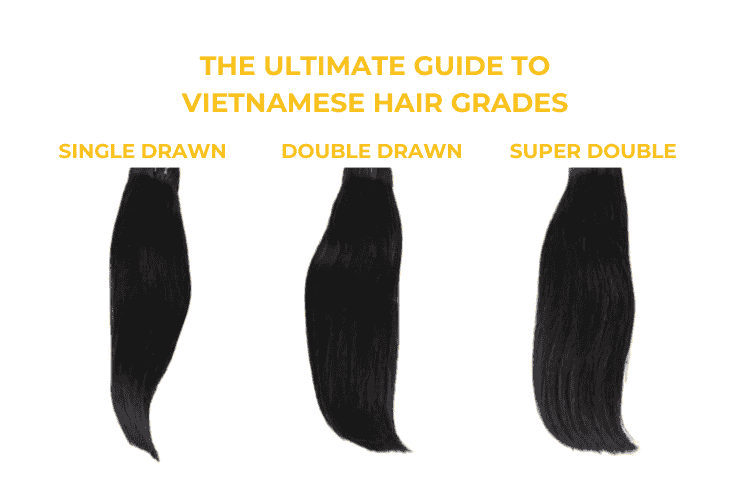
Vietnamese hair is graded by draw level — the percentage of strands in a bundle that reach the full stated length — not by the “8A/9A/10A” labels used in marketing. The four real grades are single drawn (thinnest ends), double drawn (the wholesale standard), super double drawn, and super premium / luxury (almost even density from root to tip). At Govihair, Remy hair grades as single (under 65%), double (65–75%), super (75–85%) and luxury (85%+); raw hair grades slightly lower per tier. For most buyers, double drawn is the correct grade to stock as the main product.
Understanding Vietnamese hair grade is the single biggest knowledge gap between buyers who source quality consistently and those who get burned by mislabeled inventory. This guide follows the questions a buyer actually asks, in order: why the common grade labels are fake, what the real system is, what decides a grade, how Vietnam compares to China, how to check a grade yourself, and which grade to buy for your market.
The grade numbers below are the actual sorting standards used by Vietnamese hair suppliers, not industry estimates.

Step 1 — Why the 8A / 9A / 10A Grades Are Meaningless
Before the real system, one thing has to be said clearly: the 8A, 9A and 10A grades have no standard definition in the hair industry. They were created by marketing teams, not by any quality body. Any vendor can call any hair “10A” without meeting a single testable rule. Two vendors selling “10A” can be selling completely different quality.
Serious Vietnamese factories do not use the A-grade system. They classify by draw level — the share of strands that reach the full stated length in a bundle. This is the only measurable, checkable number that actually predicts how a bundle will look and perform.
So when a vendor says “8A/9A/10A,” ask one question: what draw percentage does it reach? If they can’t answer, the grade is a label, not a specification.
Step 2 — The Real Vietnamese Hair Grade System (Draw Levels)
The Vietnamese factory system is based on tail thickness — how many strands in a 100g bundle reach the full stated length. Govihair uses two separate scales for Remy and raw hair, because raw comes from more donors and grades slightly lower at each tier:
| Grade | Remy (strands at full length) | Raw (strands at full length) |
|---|---|---|
| Single drawn | under 65% | under 60% |
| Double drawn | 65–75% | 60–70% |
| Super double drawn | 75–85% | 70–80% |
| Luxury / Super premium | 85% and up | 80% and up |
Two extra rules define the top tiers: super grade has no strands shorter than about 40cm, and luxury has none under 40cm at short lengths, rising to 50–60cm at long lengths. As a price reference, the grade upgrade costs about +$15/100g for super and +$20–30/100g for luxury.
Knowing how grades are measured is only half the job. The other half is finding a factory that will state its tail-density percentage in writing before you pay. Our comparison of raw Vietnamese hair vendors covers seven verified factories and what each one will confirm on paper.
Single Drawn
What it is: under about 60–65% of strands reach the full length. The rest are shorter strands that create a natural taper toward the ends.
How it looks: full at the top (near the weft) and thinner toward the ends. On a 20″ bundle, the first few inches are dense; the last 4–6 inches are clearly thinner.
How it feels: light. The taper copies how hair really grows from the head — thicker at the root, finer at the tips.
Best use: everyday styling, budget clients and braiding, where end density matters less. Not for blunt cuts or styles that need thickness at the tips.
Price (20″ natural straight): $28–$40 / 100g factory-direct.
Double Drawn
What it is: Remy 65–75% / raw 60–70% of strands reach full length, with most short strands removed by hand-sorting.
How it looks: clearly fuller than single drawn along the whole length; it stays thick to within the last 1–2 inches. At the same weight, a double drawn bundle feels denser because the weight is spread more evenly.
How it feels: substantial and bouncy — the full-bodied look most salon clients link with quality.
Best use: the global standard for premium wholesale. Holds curls well, works for blunt cuts, reinstalls 2–3 times, and suits tape-in and hand-tied weft.
Price (20″ natural straight): $38–$55 / 100g factory-direct. This is the double drawn Vietnamese hair most buyers should stock first.
Super Double Drawn
What it is: Remy 75–85% / raw 70–80% of strands at full length, with very few short strands and none under about 40cm.
How it looks: nearly even thickness from weft to tip, with even ends rather than a tapered fade.
How it feels: very dense and heavy, with the same weight from top to bottom.
Best use: maximum volume for luxury installs and full sew-ins. Excellent for wigs — HD lace wigs made with super double drawn give the most natural-looking thick hairline.
Price (20″ natural straight): $55–$75 / 100g factory-direct.
Super Premium (VIP / Luxury)
What it is: Remy 85%+ / raw 80%+ of strands at full length. Almost no short strands — none under 40cm at short lengths, rising to 50–60cm at long lengths.
How it looks: almost even thickness root to tip. The clearest difference from double drawn is the density in the final 2–3 inches, which is nearly as thick as the middle of the bundle.
How it feels: very dense and heavy, with the most weight and swing per bundle.
Best use: the top luxury tier — editorial work, celebrity installs and high-end wigs. Reinstalls 4–5+ times without losing quality.
Price (20″ natural straight): $72–$95 / 100g factory-direct.
Step 3 — What Actually Decides a Grade: Length and Raw Material
Grades are not set by a marketing choice — they are limited by the raw hair a factory can get. This is why the same vendor can offer luxury in 18″ but only double drawn in 28″, and it is the part most sellers never explain.
Why longer lengths rarely reach super or luxury grade
- Below 50cm (20″): raw material is easier to find and cheaper, so more strands reach full length — these lengths can be made all the way up to luxury grade.
- From 24″ and up: most suppliers can only reach double drawn. Super and luxury become very hard, because genuinely long donor hair is rare.
- Buyer beware: any supplier claiming natural bundles up to 40″ is, in most cases, blending in a large amount of synthetic fiber.
- Each supplier sets a different price to reach each tail ratio — the draw percentage, not the label, is what you are paying for.

How Vietnamese raw material is collected: donor hair vs. sorted hair
Finished-bundle quality — bulk, weft, tape, tip — starts with the type of raw material that goes in. There are two:
- Donor hair (naturally selected). Cut directly from one person’s head during trimming. Bundles hold mixed lengths, are not sorted by length, and are sold by the sack or case. There are almost no strands under 20cm. It costs more, but it bleaches very reliably (over 95% even color uptake) and takes color consistently. Its quality depends on the raw material and the harvest season.
- Sorted (re-aligned) hair. Made from collected loose hair, re-processed so root and tip run the same way. It is sorted into set lengths from 20cm (10″) to 34″, each bundle about 95% cut evenly at the tip. Factory owners buy it and blend percentages by price to reach their own quality level. Every length is available, but the share of long strands is lower (bundles are one length), it bleaches less reliably than donor hair and takes color less evenly (it comes from many donors), and its main strength is dense, even ends.
This is why bleaching reliability and color evenness differ between single-donor raw and multi-donor raw — and why the grade label alone never tells the whole story.
Raw vs. virgin at the same grade
“Raw” describes the processing level (zero chemicals, single-donor), not a draw level. Raw hair is sold in single, double, super double and super premium; raw double drawn is the most common wholesale choice. At the same draw level, raw performs differently from virgin:
- Bleaches more reliably to #613 (intact inner core, single-donor consistency).
- Lasts 2–5 years vs 1–2 years for virgin.
- Costs 20–35% more than virgin at the same draw level.
Step 4 — Vietnamese Hair Grade vs. Chinese Hair Grade
The most important point when comparing Vietnamese and Chinese hair is that the two markets grade on different systems. A Vietnamese hair grade is a measurable draw percentage; a Chinese “grade” is usually a marketing label.
- Vietnam grades by draw level — single, double, super double and luxury, each tied to a stated percentage of strands at full length. You can comb the tail and count, so it is checkable.
- China’s wholesale market runs mainly on the 8A–12A labels, which have no fixed standard, plus origin names (Brazilian, Peruvian, Indian) put on raw material imported from many sources and re-processed.
| Factor | Vietnam (draw-level system) | China (A-grade market) |
|---|---|---|
| Grading method | Measurable draw % (single to luxury) | 8A–12A labels, no fixed standard |
| Raw material | Vietnamese hair, single-donor | Imported from several origins, relabeled |
| Grade consistency | High — single-donor, stated % per tier | Varies from batch to batch (mixed sources) |
| Color range | Raw bleaches to any color + named designer tones | Widest palette (bright colors, ombre, #613 blonde) |
| Price (natural, 100g) | About $28–$95 by grade | About $22–$77 (Dec 2025 reference) — similar |
Two takeaways for buyers:
- Chinese hair is not cheaper on quality raw. At the same specification the two origins price similarly — China’s real edge is its color range, stock depth and dropshipping speed, not the price of quality raw hair.
- To compare fairly, turn every “grade” into a draw percentage. A Vietnamese factory will state one (for example, “65–70% at full length”); if a Chinese “10A” quote can’t, you are comparing a measurement against a label.

Grade Comparison Table (Quick Reference)
| Grade | Strands at full length | How the ends look | Feel | Price 20″ (100g) | Best for |
|---|---|---|---|---|---|
| Single drawn | Remy <65% / Raw <60% | Thin, tapered | Light, natural | $28–$40 | Budget, natural look |
| Double drawn | Remy 65–75% / Raw 60–70% | Full, slight thinning at the ends | Substantial | $38–$55 | Main wholesale product |
| Super double drawn | Remy 75–85% / Raw 70–80% | Very full, even ends | Dense, heavy | $55–$75 | Luxury salon, wigs |
| Super premium | Remy 85%+ / Raw 80%+ | Almost even root to tip | Maximum density | $72–$95 | Editorial, premium brand |
| Raw double drawn | 60–70% | Full | Dense, natural cuticle kept | $62–$82 | Color work, long-term clients |
| Raw super double | 70–80%+ | Very full | Premium, natural cuticle kept | $82–$110 | Luxury + color capability |
Step 5 — How to Verify a Grade Before You Buy
Comb-pull density test. Comb a 100g bundle firmly from root to tip three times, lay it flat, and look at the last 3–4 inches. Single drawn: clearly thin. Double drawn: fairly full. Super double drawn: only slightly thinner than the middle. Super premium: nearly the same as the middle.
Weight check. Hold the bundle at the weft and let it hang. Single drawn swings from a heavy top to light ends. Double drawn hangs more evenly. Super double drawn feels nearly the same weight at the weft and at the tip.
Ask for the draw percentage. A real factory states a range (for example, “65–70% at full length” for double drawn). If a vendor only offers “10A,” push for a number.
Sample before bulk. The only sure check is to order 100–200g and measure it yourself: spread the bundle flat, hold all strands from the weft end, and count what share reaches a ruler set at the stated length. Govihair’s sample minimum is 500g.

Step 6 — Which Grade Should You Stock?
- For most buyers: stock double drawn as your main product across all textures. It is the grade 80%+ of professional salon clients expect and will pay for.
- Add super double drawn for premium positioning — stock it in bone straight and body wave (the two highest-demand textures) as a clear upgrade option.
- Add single drawn only if you serve a price-sensitive segment that needs an entry-level option. Don’t make it your main product if you are building a quality brand.
- Choose raw double drawn for any market where clients do color work, reinstall several times, or are building a premium salon name. Raw pays back through its longer lifespan. See the full Vietnamese hair price list for 2026 to plan your margins.
Grade by Market
| Market | Common grade | Main reason |
|---|---|---|
| US premium salon | Raw double / super double drawn | Color work, several reinstalls, clients expect thick ends |
| US volume wholesale | Double drawn | Standard quality-to-price balance |
| Nigeria / West Africa | Double drawn (mainstream); super double (premium segment) | Volume and value; premium buyers are quality-conscious |
| South Africa | Double drawn | Mid-to-premium positioning |
| Europe (UK, Germany, Poland) | Double drawn minimum; super double for luxury | European clients notice density at the ends |
| Australia | Double drawn | Standard professional salon expectation |
| Middle East | Super double drawn, super premium | High spending power, maximum volume expected |
FAQs
What does “double drawn” actually mean in Vietnamese hair?
It means roughly 60–75% of the strands in the bundle reach the full stated length (raw 60–70%, Remy 65–75%), with shorter strands removed by hand-sorting. The result is fuller, more even density from root to tip than single drawn (under 60–65% at full length). The “drawing” is the hand-sorting work done at the factory.
Is 10A Vietnamese hair real?
The 10A grade has no standard industry definition. It is a marketing label, not a quality specification. Some vendors use it for what is really single drawn; others use it for double drawn. Always ask for the draw percentage instead of trusting A-grade labels.
What’s the difference between raw and double drawn?
“Raw” describes processing (single-donor, zero chemicals). “Double drawn” describes strand-length spread (60–75% at full length). They are two different measures. The most common premium choice that combines both is “raw double drawn.”
Which grade is best for wigs?
Super double drawn or super premium makes the best wigs, because even density from weft to tip creates a natural hairline and consistent density across the whole unit. For frontal wigs, super double drawn in the hairline gives the most realistic gradual density.
How much price difference is there between single and double drawn?
About 25–40% more for double drawn at the same length, texture, and raw-vs-virgin level. The difference reflects the extra hand-sorting labor — removing 30–40% of the shorter strands to make double drawn takes significant time.
How do Vietnamese hair grades compare to Chinese hair grades?
Vietnamese factories grade by measurable draw level (the percentage of strands at full length), while the Chinese wholesale market mostly uses the 8A–12A labels, which have no standard definition. Vietnamese raw is single-donor and locally collected, giving more consistent grade and color, whereas much Chinese “raw” is imported from several origins and relabeled. Quality raw is comparably priced; China’s advantage is color range and stock depth, not a lower price.
Related: Vietnamese Hair — Complete Guide | Vietnamese Hair Price 2026 | Double Drawn Vietnamese Hair | Top 10 Vietnamese Hair Vendors

 Ms. Victoria