

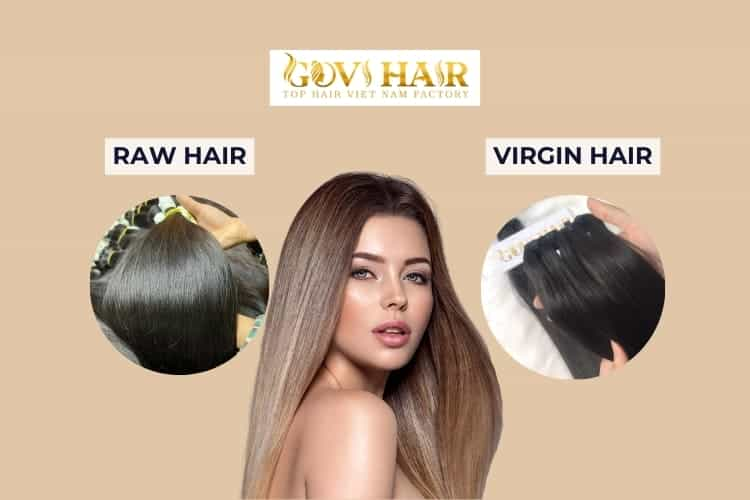
Do you know the difference between raw hair vs virgin hair? If you are learning about artificial hair, you must know about this distinction. In this article, Govihair will distinguish these two terms as well as provide more related information to you.
What is Raw Hair?
Raw hair is 100% unprocessed human hair extensions collected from a single donor. It has never been chemically treated or altered in any way, preserving the natural cuticle alignment. It maintains its original pattern-whether straight, wavy, or curly-and is known for its durability can withstand high temperatures
- Available Lengths: 8” to 32” (and sometimes longer)
- Texture: Coarse, natural feel
- Processing: None-completely raw
Raw Hair Pros:
- Long-lasting (can last 3+ years)
- 100% natural and chemical-free
- Raw hair bleaching and coloring as natural hair
Raw Hair Cons:
- Higher cost
- May require more maintenance

>> Read More: Top 7 Wholesale Raw Hair Vendors Worldwide in 2024
What is Virgin Hair?
In the hair business, hair that has never undergone chemical treatment or processing is referred to as virgin hair. This indicates that the hair has not undergone any chemical treatments that could change its natural texture or color, such as dying, perming, bleaching, or other chemical treatments. Virgin hair is prized for its quality and authenticity when it is in its original, unmodified state.
Virgin hair is also unprocessed and comes from multiple donors. While still of high quality, it’s slightly more refine
- Available Lengths: 8” to 32”
- Texture: Smoother, silkier feel
- Processing: None—completely virgin
Virgin Hair Pros:
- Affordable and versatile
- Uniform texture, easy to manage
- Suitable for daily use and resale business
Virgin Hair Cons:
- Shorter lifespan than raw hair
- Some textures are not completely natural (steam processed)

>> Read More: Top 5 Best Trusted Virgin Hair Vendors For Wholesale Business In 2025
What is The Difference Between Raw Hair vs Virgin Hair?
Raw hair vs virgin hair in terms of treatment
- Virgin hair and raw hair are both unprocessed and haven’t had any chemical treatments like perming, bleaching, coloring, or any other changes made to it.
- To provide a high-quality, unaffected hair product, they are harvested from donors in their natural state, with the cuticles intact and aligned in the same direction.
Regard to supply
Raw hair:
- Sources of Collection: Generally, raw hair is gathered from a variety of sources, such as salons, hair collectors, multiple donors, and other outlets. The hair may come from different individuals, resulting in natural variations in texture, color, and length within a single batch of raw hair.
- Availability: Since raw hair comes from different donors and places, it might be easier to find. This may facilitate finding and making larger-scale purchases.
- Variability: Raw hair may have more inherent flaws and variations as a result of its varied sourcing, which makes it a less uniform product.
Virgin hair:
- One Donor: Virgin hair is usually obtained from a single donor, which means that each bundle or batch of hair is derived from the same person. As a result, a bundle’s texture, color, and length are more uniformly distributed.
- Virgin hair is subjected to more stringent quality control procedures in order to guarantee consistency and superior quality. Donors are often carefully selected to fulfill predetermined requirements.
- Availability: Due to the more stringent sourcing regulations, virgin hair might be harder to come by than raw hair. On the other hand, its consistency and quality make it extremely valuable.
In Terms of Textures
Textures of Raw Hair:
- There is a broad spectrum of textures that can be seen in raw hair, such as curly, kinky, wavy, and straight. Depending on the sources and donors, raw hair bundles may have different, specific textures.
- The texture of raw hair varies from bundle to bundle because it is frequently collected from multiple donors. Raw hair is known for its inherent variation.
Textures of Virgin Hair:
- There are also other textures available for virgin hair, including straight, wavy, curly, and kinky. The texture of virgin hair, however, is typically more consistent when it comes from a single donor.
- Because virgin hair is more rigorously inspected and donors are frequently chosen based on their particular hair type and texture, each bundle of virgin hair may have a more uniform texture.

In Terms of Grade
Raw Hair Grading:
- Unlike processed hair extensions, raw hair is frequently not graded according to a set system. Rather, individual hair traits like texture, length, and condition are frequently used to evaluate quality.
- Quality can vary between different sources and batches of raw hair, and it may be described based on these characteristics, with terms like “high-quality,” “premium,” or “luxury” used to indicate superior raw hair.
Virgin Hair Grading:
- Virgin hair is also not typically assigned standardized grades. Nonetheless, the evaluation of virgin hair quality frequently takes into account elements like the hair’s overall condition, texture, and origin.
- Higher-quality virgin hair is frequently obtained from donors who meet particular requirements, like having healthy, unprocessed hair. It is usually linked to more consistency in appearance and texture.
In Terms of Smell
- Since virgin hair and raw hair are usually obtained from donors without being chemically processed, they should ideally smell neither artificial nor unpleasant. One crucial aspect of both kinds of hair is that they don’t have any peculiar or strong smells.
- In order to guarantee that they are free of any dirt, debris, or odors that may have been picked up during collection or handling, virgin hair and raw hair are usually cleaned and sanitized during the preparation process. A natural hair product that smells strongly or disagreeably could have been handled poorly or is of inferior quality. In these situations, it’s best to get in touch with the vendor or supplier to discuss any issues you may have with the hair’s general quality and smell.
Bleaching and Dying
Raw Hair:
- Raw hair can be bleached and dyed, but it might take more work to get the right shade or color. The degree to which color and texture naturally vary could influence how well bleach or dye takes.
- Variations in raw hair may cause color outcomes to vary from bundle to bundle. For this reason, buying enough hair from the same batch is crucial to guaranteeing a consistent color result.
Virgin Hair:
- Virgin hair is also safe to bleach and dye. However, because it usually comes from a single donor and has a uniform texture and color, it frequently yields a more consistent and predictable result.
- Because virgin hair retains its integrity well during the coloring process and is consistently capable of producing the desired color, many people choose it for coloring.
In terms of durability
Raw Hair Durability:
- Because it has not been chemically processed and has retained its natural qualities, raw hair is typically more durable. Tangling and matting can be avoided when cuticles are still whole.
- Raw hair’s longevity can differ based on the precise sourcing and quality assurance procedures used. Better-quality raw hair will probably last longer and be more resilient.
Virgin Hair Durability:
- Due to its unprocessed nature and preservation of its original cuticle alignment, virgin hair is also incredibly durable.
- Virgin hair that comes from a single donor frequently has very consistent length and texture, which can increase its durability.
Raw hair vs Virgin hair Price
Raw Hair Price:
- In general, raw hair is less expensive than virgin hair. It frequently comes from different donors and places, which may cause organic variances in texture, color, and length.
- Raw hair is less expensive because of its varied sourcing and potential for greater quality and characteristic variations.
Virgin Hair Price:
- In general, virgin hair costs more than raw hair does. This is due to the fact that virgin hair frequently comes from a single donor, producing more texture, color, and length uniformity.
- Virgin hair can cost more because it is subjected to stricter quality control procedures that guarantee high quality.
In terms of Market
Different markets have different preferences based on climate, hair trends, and customer needs.
Raw Hair:
- Raw hair is highly preferred in European and Middle Eastern markets. These customers value natural texture, longevity, and premium quality. Raw hair is ideal for high-end clients and salons that prioritize authenticity and customization.
Virgin Hair:
- Virgin hair is extremely popular in African markets. It offers a balance between quality and affordability. The textures and styles are well-suited for protective styling and are easier to manage for daily wear.
Which is better? Virgin or Raw hair
Depending on your needs and preferences, virgin or raw hair may be preferable. The decision between the two is arbitrary and based on your priorities because each type has pros and cons of its own. The following are some things to think about when choosing which is better for you:
Virgin Hair:
- Uniformity: Virgin hair has a high level of texture, color, and length uniformity, especially when it comes from a single donor. This may facilitate the creation of a dependable and unified appearance.
- Quality Control: To guarantee superior quality, virgin hair frequently goes through more stringent quality control procedures. Donors are carefully chosen to fulfill predetermined requirements.
- Ease of Coloring: Because virgin hair offers a more dependable and consistent canvas for attaining the desired color, it is frequently chosen for coloring.
Raw Hair:
- Variety of Textures: There are many different natural textures that raw hair can display. If you’re looking for a certain natural look that matches your own hair, this may be preferred.
- Cost: Because raw hair comes from a variety of sources, it is usually less expensive than virgin hair, making it a cost-effective choice for premium wigs or hair extensions.
- Natural Variations: Some people prefer a less uniform appearance, and raw hair may offer a more natural look with subtle variations.
Where are raw hair and virgin hair sourced from reputable Suppliers?
Virgin and raw hair are frequently obtained from reliable distributors and suppliers across international borders. When searching for reputable suppliers of superior hair, you may want to take into account the following:
- Brazil: Brazil is a well-known supplier of virgin hair and other high-quality human hair. Brazilian hair is frequently complimented on its resilience and texture.
- India: Among the world’s biggest suppliers of human hair is India. Indian hair is well-liked for its adaptability and variety of textures.
- Peru: The natural thickness and smoothness of Peruvian hair make it highly valued. It’s a fantastic resource for raw vs virgin hair extensions .
- Southeast Asia: Vietnam and Cambodia are well-known for providing premium raw hair. Vietnamese and Cambodian hair is highly prized for its smooth, straight texture.
- Online Retailers: Reputable suppliers and retailers focus on locating and offering virgin, raw hair. These vendors offer a large selection of textures and quality levels and may source hair from different nations.

One of the most reliable stores in Vietnam for human hair is Govihair. As known as the best Vietnamese hair suppliers, We offer items that are entirely composed of human hair from Vietnam. Having produced artificial hair for over 20 years, we are confident in the caliber of our offerings. These are our details for contact:
- WhatsApp: (+84) 795 746 986
- Email: [email protected]
- Instagram: govihair_vietnamhair_factory
- TikTok: govihairvietnam_official
- Website: govihair.com
In conclusion, Govihair gives you a wealth of information that is very helpful and is an essential resource if you are looking for specific details about raw hair vs virgin hair. Remember to check out our website for more fantastic information about artificial hair that you can save for later.


 Ms. Sophia